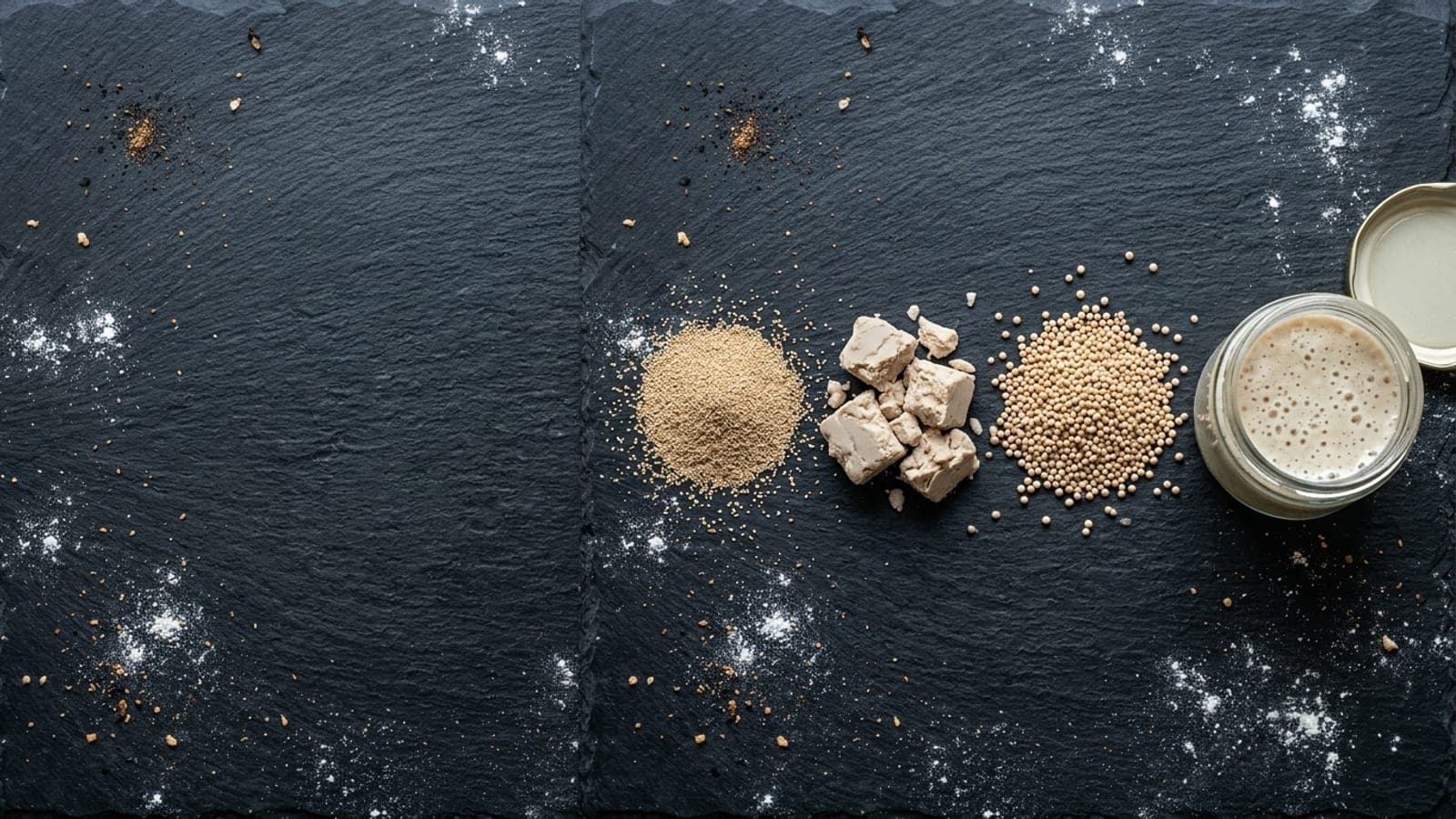
Yeast converter — fresh, dry & sourdough
The recipe says fresh yeast, the cupboard says instant. No drama — the four kinds of yeast swap cleanly by weight, as long as you respect their ratios. Pick what you have, type the grams, and read off what raises the same dough.
What you have
Same rise means same plan — these ratios hold for whatever hours and temperature you had in mind. Sourdough is the one diva: a 100%-hydration starter brings its own flour and water, so beyond a spoonful, rebalance the dough — or let the calculator do it for you.
Why the amounts differ
Fresh yeast is about 70% water — a soft block of cells with a short fridge life. Drying it concentrates the living part: active dry keeps the cells in a dormant coat, instant dries them finer still. So gram for gram, instant is the strongest and fresh the gentlest. Sourdough starter goes the other way entirely: it’s mostly flour and water, with the wild yeasts as a minority share, so you need far more of it by weight.
These weights all raise the same dough:
| Yeast | Same rise |
|---|---|
| Instant dry (IDY) | 1 g |
| Active dry (ADY) | 1.2 g |
| Fresh | 3 g |
| Sourdough starter | 75 g |
The ratios come straight out of the calculator’s fermentation model, so the two can never disagree — and they hold for any schedule, because time and temperature scale every yeast the same way.
The cheat sheet
The shapes yeast actually arrives in, converted. A sachet here is the standard 7 g (¼ oz) packet of dry yeast; the cube is the 25 g block of fresh from the refrigerated aisle.
| You have | IDY | ADY | Fresh |
|---|---|---|---|
| A sachet — 7 g IDY | 7 g | 8.4 g | 21 g |
| A fresh cube — 25 g | 8.3 g | 10 g | 25 g |
| 1 level tsp dry — 3.1 g | 3.1 g | 3.7 g | 9.3 g |
Swapping in a recipe is just that: replace the listed yeast with the same-rise weight of yours. One habit per type — wake active dry in a little warm water for 5–10 minutes first, whisk instant straight into the flour, and crumble fresh into the water like a tiny snowfall.
Sourdough, the special case
Starter converts like the others — about 25× the weight of fresh yeast — but it isn’t inert: a 100%-hydration starter is half flour, half water. A tablespoon (~15 g, the same rise as 0.2 g of IDY or 0.6 g of fresh) disappears into any dough unnoticed. A real sourdough dose doesn’t — take half the starter’s weight off the recipe’s flour and half off its water, or the hydration quietly creeps up.
The sourdough guide walks the whole model, and the calculator’s sourdough mode does the rebalancing for you.
Questions from the counter
My recipe says one packet — how many grams?
A standard packet (sachet) of dry yeast is 7 g, about 2¼ level teaspoons. If you’re paying in other currencies: 8.4 g of active dry or 21 g of fresh.
Do I change the water or flour when I swap?
Between instant, active dry and fresh — no. The doses are so small the dough never notices. To or from sourdough starter, yes: half of it is flour and half water, so subtract accordingly (or let the calculator do the bookkeeping).
Is rapid-rise or bread-machine yeast the same as instant?
Close enough to treat as instant, 1:1. They’re the same fine-milled dry yeast, sometimes with a pinch of conditioners — nothing your dough will argue about.
Does swapping change my schedule?
No — that’s the point of converting by same rise. The dough hits the same readiness at the same hour; only the weight on the scale changes.
The other half of the question
This tool answers “swap what I have.” The calculator answers “how much do I need” — it sets the dose from your hours and kitchen temperature, in whichever yeast you choose, and writes the schedule around it.
The clock is a suggestion. The dough is the boss. In bocca al lupo!