Sourdough in pizza dough — the guide
Sourdough pizza isn’t a different sport — it’s the same time-and- temperature game with a livelier player. Your starter (the Italians say lievito madre) replaces the commercial yeast entirely, brings its own flour and water to the bowl, and asks for noticeably bigger numbers on the scale.
This guide covers how the calculator doses a starter, where its flour and water go, how to keep it lively enough for pizza, and what the acidity does to your dough — and it hands you the full sourdough pizza dough recipe, weighed to the gram. The clock arithmetic underneath is the same one explained in the yeast guide.
What the model assumes
One starter, two assumptions. First: it’s kept at 100% hydration— fed equal weights of flour and water — so every gram of starter is half flour, half water. Second: it’s active — recently fed, at or near its peak, not a sleepy jar straight from the fridge.
The dose lives on a much higher shelf than yeast: 2–40% of the flour weight, where fresh yeast runs in fractions of a percent. On a spoon, starter weighs about 15 g per tablespoon — the same conversion the calculator’s “cups” mode uses.
The dose: same clock, bigger numbers
The calculator converts your plan into effective hours — activity doubling every 7 °C, fridge hours counting for little — exactly as it does for yeast, then doses the starter inversely: starter % ≈ 150 ÷ effective hours, clamped to 2–40%.
The anchor worth memorizing: a 24-hour rise at 20 °C wants 6.25% starter — that’s 25× the fresh-yeast dose for the same plan, because a starter is mostly flour and water with the microbes along for the ride.
| The plan | Starter | Starter / 500 g flour |
|---|---|---|
| 4 h @ 24 °C | 25.2% | 126 g |
| 8 h @ 21 °C | 17.0% | 85 g |
| 24 h @ 20 °C | 6.3% | 31 g |
| 2 h + 24 h fridge (4 °C) | 21.0% | 105 g |
| 48 h @ 18 °C | 3.8% | 19 g |
The fridge row is the practical sweet spot: the cold stretches the schedule, the acidity stays in check, and the dose stays in easy-to-weigh territory. The cold fermentation guide covers that half of the plan.
Where the starter’s flour and water go
A starter isn’t an add-on; it’s part of the recipe. The calculator counts its flour and water toward the totals, half and half, and subtracts them from what you add at the mix — so the hydration you chose stays honest.
Worked through 4 × 260 gNeapolitan balls on the 24-hour plan: the recipe’s true flour is 631 g, so the starter is 6.3% of that — 39 g, or about 2 ⅔ tbsp. Its 20 g of flour and 20 g of water come off the adds, and the bowl gets:
| Ingredient | Weight |
|---|---|
| Starter (100% hydration) | 39 g |
| Flour | 611 g |
| Water | 372 g |
| Salt | 18 g |
Add it up and it’s 1040 g on the nose — four balls of 260 g, at exactly 62% hydration once the starter’s water is counted. No spreadsheet required; switching the yeast type to sourdough does all of this.
The recipe: a sourdough Neapolitan
Here it is as a recipe — 4 Neapolitan balls of 260 g on the 24-hour plan above, the sourdough pizza dough recipe the calculator writes. Change the count, the style or the schedule and it re-weighs every line.
- 611 g flour (00 or strong bread flour)
- 372 g water
- 39 g active sourdough starter, 100% hydration
- 18 g fine salt
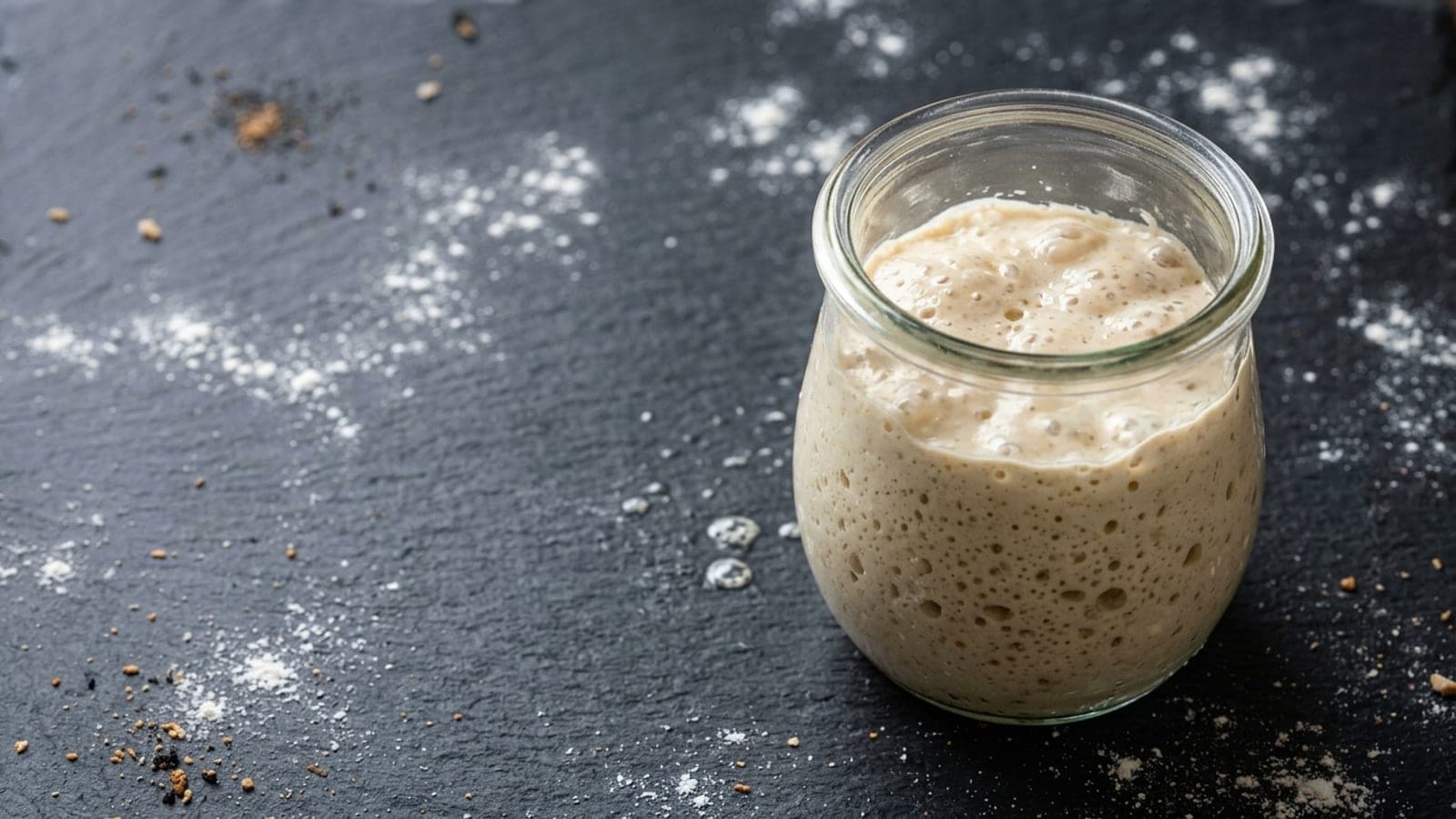
- Feed your starter 4–8 hours ahead and use it at its peak — domed, airy, roughly doubled, smelling of yogurt and ripe fruit.
- Mix the 611 g flour with the 372 g water until no dry flour remains, then rest 20–30 minutes (the autolyse).
- Add the 39 g starter and 18 g salt, and knead until smooth and elastic, 8–10 minutes.
- Bulk-ferment about 24 hours at 20 °C / 68 °F, until risen, domed and jiggly. (Set your real hours and temperature in the calculator and it re-doses the starter.)
- Divide into 4 × 260 g pieces, shape tight balls, and rest them 30–60 minutes until relaxed.
- Stretch each ball by hand, top simply, and bake as hot as your oven will go — a Neapolitan bakes in a flash; cooler ovens and pan styles take longer (see the oven guide).
The bake is a Neapolitan’s — fastest and hottest of the styles. The oven guide covers the heat for every other style if you’re baking something thicker.
Keeping it lively
The model assumes a starter at the top of its game, and that part is on you. Feed it 4–8 hours before mixing (at warm room temperature) and use it at its peak: domed, airy, roughly doubled, smelling of yogurt and ripe fruit rather than vinegar or nail polish.
A starter that lives in the fridge wants one or two wake-up feeds before pizza day. Using it cold and sluggish won’t ruin anything — it will just ferment slower than the math expects, so the schedule drifts late. When in doubt, watch the dough, not the clock: doubled, jiggly, sweet-smelling means ready.
Converting a yeast recipe
The honest answer: change the yeast type in the calculator and let it re-weigh everything — the dose, and the flour-and-water accounting above, both change.
For napkin math, the model’s ratios are constant: starter ≈ 25× a fresh-yeast dose, or 75× an instant-dry dose, for the same plan. Just remember the starter brings half its weight in flour and half in water — subtract those from the recipe’s adds or the dough ends up wetter than written.
What the acidity does
Sourdough’s bacteria make lactic and acetic acid alongside the rise. In moderation that’s the whole point: depth, a gentle tang, better keeping, and a crust that browns beautifully.
Push the ferment very long and very sour, though, and the acid starts working on the gluten itself — the dough turns slack, fragile, tears at stretching time. If that’s your experience, ferment cooler, shorten the warm hours, or feed the starter more often so less acid comes along in the dose. Sour is seasoning, not a victory condition.
Questions from the counter
Can I use starter straight from the fridge?
You can, but the math assumes an active one — cold, hungry starter ferments slower, so everything runs late. Give it a feed and a few warm hours first; pizza is worth the courtesy.
My starter isn’t 100% hydration — does it matter?
A little. A stiffer starter brings more flour and less water per gram, so the dough lands slightly drier than planned — at typical doses the drift is a fraction of a hydration point. Either ignore it or add a splash of water; don’t overthink it.
Can I add a poolish or biga too?
No — and the calculator hides the option for sourdough. A starter already is a preferment with wilder tenants; the poolish & biga guide explains the family resemblance. One head start per dough.
Why isn’t my pizza very sour?
Probably because you did everything right — a young starter used at peak, on a reasonable schedule, gives lift with only a whisper of tang. For more sour: longer and warmer ferments, or a starter fed less frequently. Mind the gluten (see above).
Is sourdough better than yeast for pizza?
Different, not better. Sourdough buys complexity and character; yeast buys precision and convenience. The dough math treats them as equals — pick by the flavor you want on Friday, not by ideology.
Feed the pet, open the app
Switch the yeast type to sourdough and the calculator re-doses for your hours and temperatures, weighs the starter, and quietly fixes the flour and water behind the scenes.
The clock is a suggestion. The dough is the boss. In bocca al lupo!