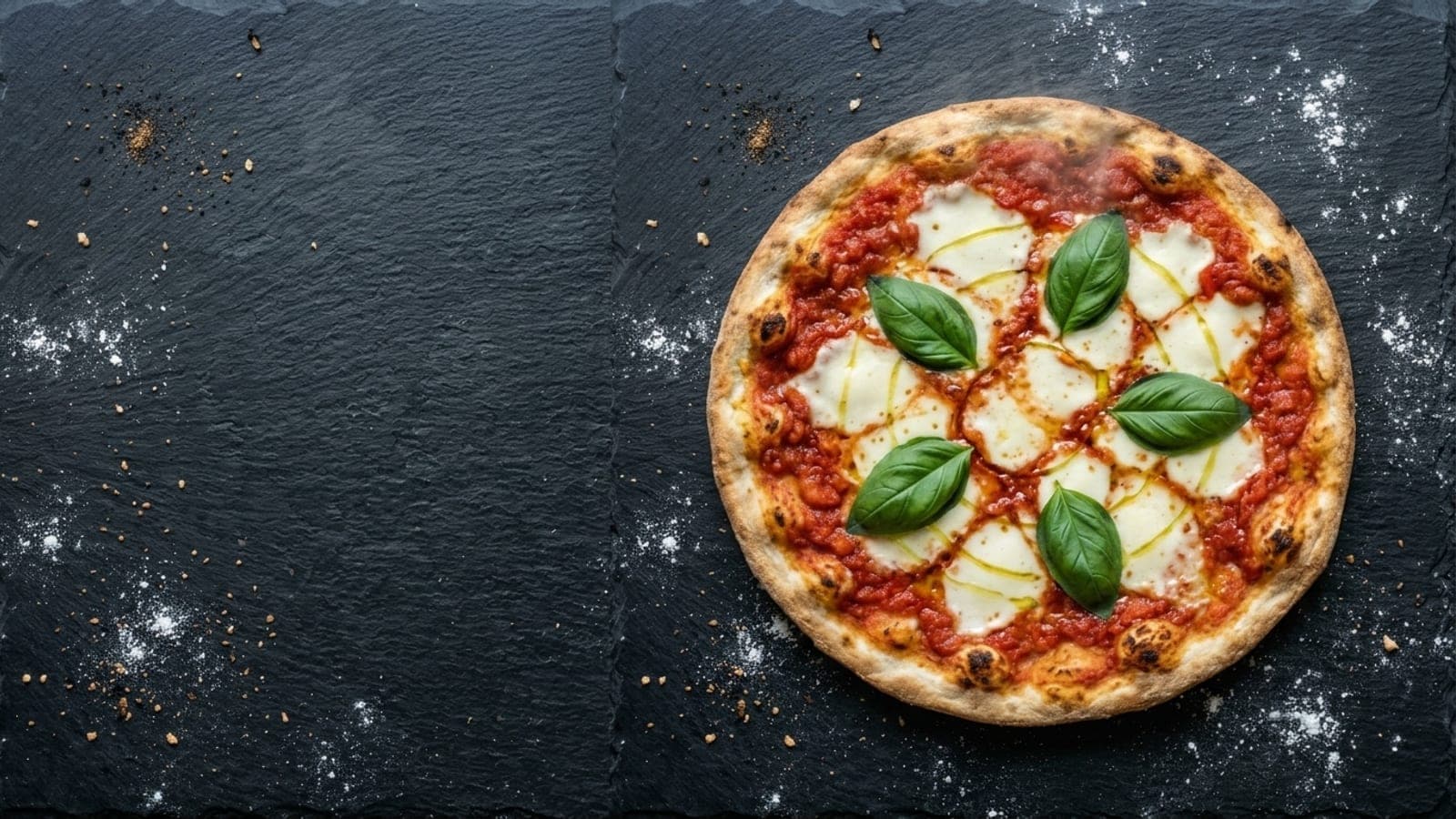
Tonda romana — the recipe
Rome's everyday round, and the anti-Neapolitan: where Naples wants a puffy, blistered cornicione, the tonda romana is rolled and stretched cracker-thin, then baked until it's crisp edge to edge and snaps when you fold it — scrocchiarella, the Romans call it, after the sound. Same tomato, mozzarella and basil; opposite crust.
Thin means restraint. The doses below run lighter than a Neapolitan's, because a wet, loaded top steams a crisp base back into a soft one. Everything is weighed per ball and scales with your dough — get the cracker crust from the Thin & crispy preset.
What goes on top
Per pizza, on the default 180 g ball — in layering order:
a thin spiral; it helps the surface crisp
Stretching bigger or smaller? The model rescales with the dough:
| Topping | 140 g ball | 180 g ball | 230 g ball |
|---|---|---|---|
| Crushed tomatoes | 45 g | 60 g | 75 g |
| Fresh mozzarella | 40 g | 50 g | 65 g |
| Extra-virgin olive oil | 4 g | 5 g | 6 g |
| Fresh basil | 4 leaves | 5 leaves | 6 leaves |
The dough
Tonda romana is built on Thin & crispy dough. Scrocchiarella — cracker-thin, rolled out, snaps when you fold it. For 4 × 180 g balls:
| Ingredient | Baker's % | For 4 pizzas |
|---|---|---|
| Flour | 100% | 447 g |
| Water | 56% | 250 g |
| Salt | 2.5% | 11 g |
| Olive oil | 2.5% | 11 g |
| Yeast | 0.23% | 1 g |
The yeast is weighed for an example 8 h rise at 21°C — your kitchen disagrees, and that’s the point: set your real schedule in the calculator and it reweighs the pinch.
How it’s done
- Make the dough: 4 × 180 g Thin & crispy balls — the calculator weighs the flour, water, salt and yeast for your schedule.
- Stretch each ball on a little flour, pressing the air from the middle out to the rim.
- Top with 60 g crushed tomatoes (a thin, even coat — a flooded crust never crisps).
- Top with 50 g fresh mozzarella (torn and drained hard — water is the enemy of a thin crust).
- Top with 5 g extra-virgin olive oil (a thin spiral; it helps the surface crisp).
- Bake at 300 °C / 572 °F — on a preheated steel or stone if you have one.
- After the bake: 5 fresh basil leaves — torn over the hot pizza.
Questions from the counter
How is a tonda romana different from a Neapolitan?
The crust, not the toppings — both can be a plain margherita. The Neapolitan is hand-stretched, left with a thick rim, and baked fast and soft so it folds; the tonda romana is rolled thin and even, often docked, and baked until it's crisp all the way through, so it snaps. One is pillowy, the other is a cracker.
How do I get it cracker-crisp?
Four things, in order: a low-hydration dough (the Thin & crispy preset's 56% is built for it), rolled thin with a pin rather than hand-stretched, a hot stone or steel under it, and a light, well-drained top — a flooded pizza steams instead of crisping. Docking the rolled base with a fork keeps it from ballooning into bubbles.
Do I roll it or stretch it?
Roll it — the tonda is one of the few pizzas that wants a pin. A rolling pin gives the even, thin, bubble-free sheet the style is named for, where hand-stretching leaves a thicker rim and an uneven middle. Stretch the last bit by hand if you like, but the pin does the real work.
Get the dough
The Thin & crispy preset weighs the balls and writes the schedule — mix, rise, ball, stretch, bake.
The clock is a suggestion. The dough is the boss. In bocca al lupo!