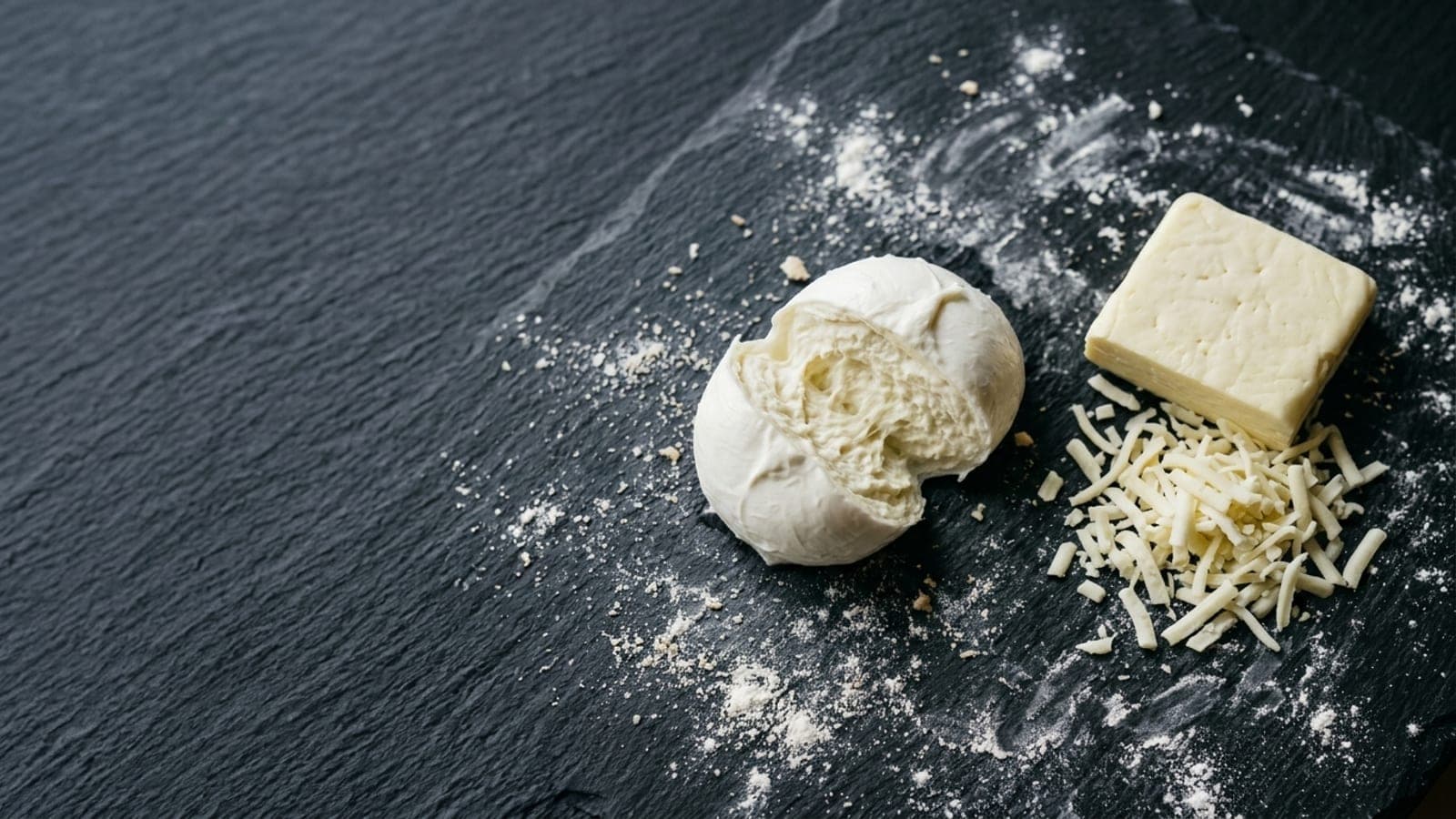
Mozzarella on pizza — the topping
Half the questions a pizza ever raises are secretly mozzarella questions: why the middle went soupy, why the cheese browned before the crust did, why it never looks like the pizzeria's. The answer is almost always which mozzarella — fresh or low-moisture — and how wet it went on.
Both kinds live in the classic recipes here, weighed per pizza. This page is what to buy, how to handle it, and the doses — read from the same registry the recipe pages scale, so the numbers always agree.
What to buy
Fresh mozzarella — fior di latte, the soft white ball in brine — is milky, tender and made for fast, ferociously hot bakes. Buy cow's-milk balls firm enough to slice; the fancy buffalo version is wonderful and even wetter, so it asks for twice the draining discipline.
Low-moisture mozzarella is the same cheese aged drier: saltier, stretchier, and it browns evenly through a long moderate bake instead of weeping through it — the New York cheese. Buy it in a block and shred it yourself; pre-shredded bags are dusted with anti-caking starch that turns the melt grainy.
The split follows your oven, not your taste: short blistering bakes take fresh, and anything that bakes for six minutes and up wants low-moisture. That's why the Neapolitan classics tear fior di latte while the pepperoni pie shreds the block — swap them and you inherit the other one's problems.
Working with it
Fresh mozzarella is mostly water with ambitions. Tear it into rough thumb-size pieces — torn edges melt softer than knife-cut ones — and do it an hour ahead, spread on paper towels, so the whey leaves on the towel instead of on the pizza. Nearly every recipe that uses it here carries the same stamp: torn and well drained.
The block gets the opposite treatment: shred it coarse and lay it edge to edge, right over the sauce, so the whole surface melts into one sheet before the toppings land on top. Coarse shreds melt into bubbles; fine shreds vanish into oil.
On the pizzas
The classics that use it, with the amount each takes at its default size — the same numbers their recipe pages scale to your dough:
| Pizza | As | Per pizza | When |
|---|---|---|---|
| Margherita | Fresh mozzarella | 80 g | before the bake |
| Diavola | Fresh mozzarella | 70 g | before the bake |
| Quattro formaggi | Fresh mozzarella | 60 g | before the bake |
| Prosciutto e funghi | Fresh mozzarella | 70 g | before the bake |
| Pepperoni | Low-moisture mozzarella | 110 g | before the bake |
| Capricciosa | Fresh mozzarella | 70 g | before the bake |
| Quattro stagioni | Fresh mozzarella | 70 g | before the bake |
| Boscaiola | Fresh mozzarella | 70 g | before the bake |
| Bufalina | Buffalo mozzarella | 70 g | before the bake |
| Napoli | Fresh mozzarella | 70 g | before the bake |
| Grandma | Low-moisture mozzarella | 150 g | before the bake |
| Hawaiian | Low-moisture mozzarella | 110 g | before the bake |
| Ortolana | Fresh mozzarella | 130 g | before the bake |
| Pinsa mortadella e stracciatella | Fresh mozzarella | 50 g | before the bake |
| Tonda romana | Fresh mozzarella | 50 g | before the bake |
| Chicago tavern | Low-moisture mozzarella | 95 g | before the bake |
| 'Nduja | Fresh mozzarella | 70 g | before the bake |
Questions from the counter
Can I swap one for the other?
Downhill works, uphill doesn't. Low-moisture on a Neapolitan survives the bake — you just get a saltier, heavier pizza than the recipe intends. Fresh on a New York or pan bake weeps for six straight minutes and floods the middle; if you must, drain it ruthlessly and add it halfway through the bake. Matching the recipe is easier than outsmarting it.
Why did my pizza go watery in the middle?
Fresh mozzarella went on wet, or there was too much of it crowded in the center. Tear and drain it an hour ahead, scatter it to the edges, and hold the dose — the recipe pages weigh it for exactly this reason, and the table above is the same number their pages scale to your ball.
What about buffalo mozzarella?
Mozzarella di bufala is the luxury option and the wettest thing in the case — more cream, more whey, more flavor. It earns its keep torn over a margherita — the bufalina recipe weighs exactly that pizza — but drain it twice as long, use a little less than the fior di latte dose, and accept a softer middle as part of the deal.
Put it on a pizza
The dough is the calculator’s job and the doses are scaled on the recipe pages — this one is ready for any of the classics above.
The clock is a suggestion. The dough is the boss. In bocca al lupo!