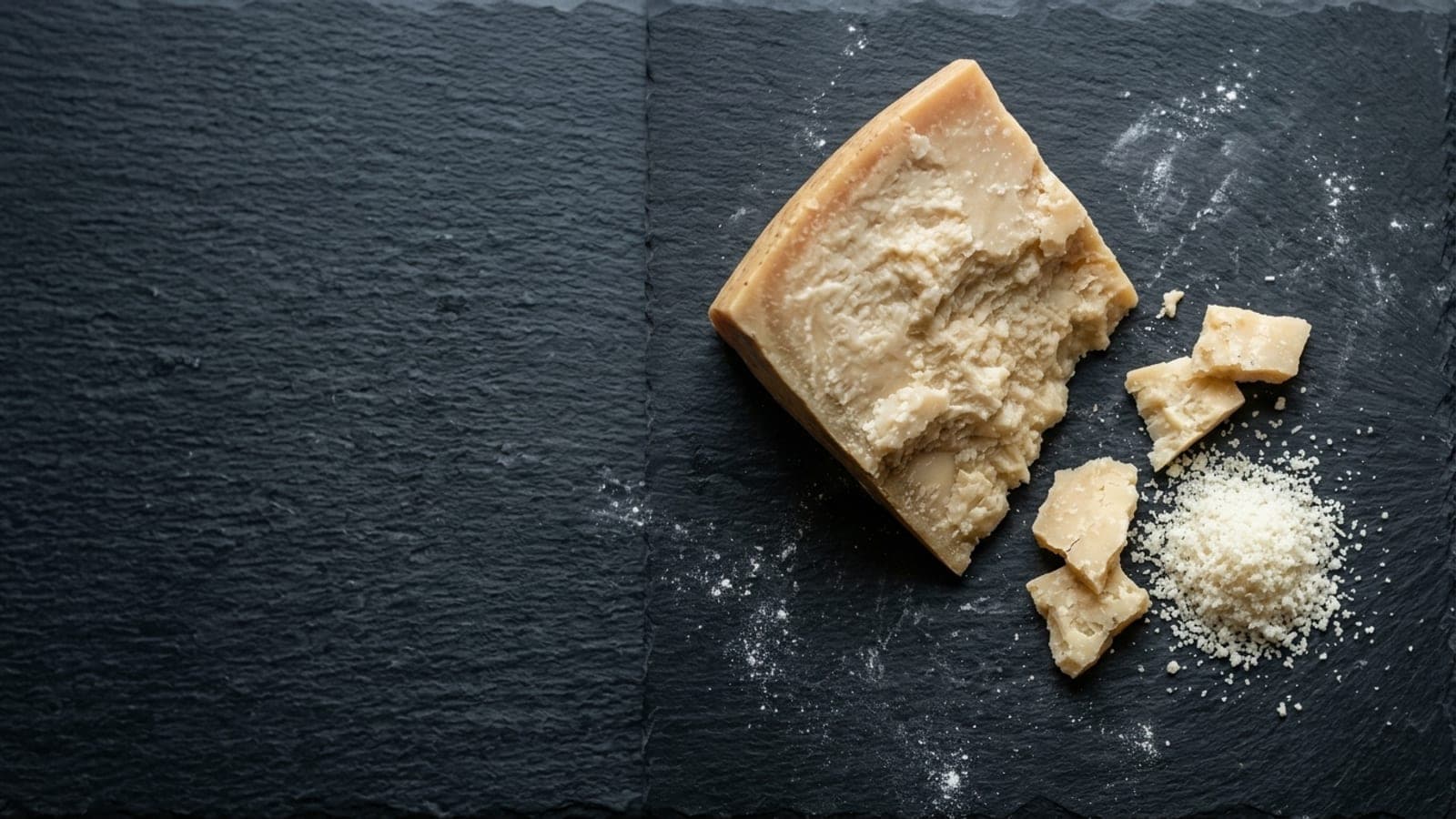
Parmigiano on pizza — the topping
Parmigiano is the cheese on the quattro formaggi that isn't there to melt. The other three do the flowing and stretching; the parmigiano is seasoning — salt with a pedigree, crystals and broth-depth grated over the top to toast into everything beneath it.
This page is the buying (one genuinely important rule), the grating, and the dose — which is smaller than you think, from the same registry the recipe page scales.
What to buy
Buy a wedge cut from a wheel stamped Parmigiano Reggiano, with the rind on — the rind is the label, the proof, and a future soup ingredient. Grana Padano is the honest budget deputy: same family, gentler and a little less crystalline, and nobody on a pizza will press charges.
What matters more than the name is the form: never the pre-grated tubs or the green shaker, which trade the perfume for anti-caking powder and a faint aroma of cardboard. A wedge keeps for weeks wrapped in paper; grate it the hour you use it and it's a different ingredient entirely.
Working with it
On the quattro formaggi it goes on before the oven — grated over the rest, says the recipe — so it toasts into the melting cheeses as a savory crust rather than sitting on top as dust. It can't melt like the others; it's too dry and too old for that, which is exactly why it browns and seasons instead.
Grate it fine for the bake — fine shreds vanish into the surface and season everything they touch. The other legitimate move is shavings over a finished white pie, peeled with a vegetable peeler, where the sharp perfume stays raw; that's a different effect, not a substitute for the baked version.
On the pizzas
The classics that use it, with the amount each takes at its default size — the same numbers their recipe pages scale to your dough:
| Pizza | Per pizza | When |
|---|---|---|
| Quattro formaggi | 15 g | before the bake |
| Grandma | 15 g | before the bake |
Questions from the counter
Parmigiano, Parmesan, Grana Padano — what's the actual difference?
Parmigiano Reggiano is the protected original: specific provinces, specific rules, minimum age, rind stamps to prove it. Grana Padano is its larger, gentler-regulated cousin — a real cheese with a real pedigree, just a softer-spoken one. 'Parmesan' with no surname can legally be almost anything, which is why the wedge with the stamped rind is the only label worth trusting.
Why does the recipe use so little?
Because it's seasoning, not filling. Parmigiano carries the salt and glutamate of the whole blend — the quattro formaggi already has three melting cheeses doing volume, and doubling the parmigiano mostly doubles the salt. The dose table above holds the number, and the recipe page rescales it with your ball.
Should parmigiano go on before or after the bake?
The quattro formaggi bakes it: grated fine before the oven, it toasts into the other cheeses and deepens them. After the bake is the other school — cool shavings on a hot white pie, all perfume and crunch. Both are legitimate; they're just different dishes. The one wrong answer is the shaker can, whose timing problems are the least of it.
Put it on a pizza
The dough is the calculator’s job and the doses are scaled on the recipe pages — this one is ready for any of the classics above.
The clock is a suggestion. The dough is the boss. In bocca al lupo!