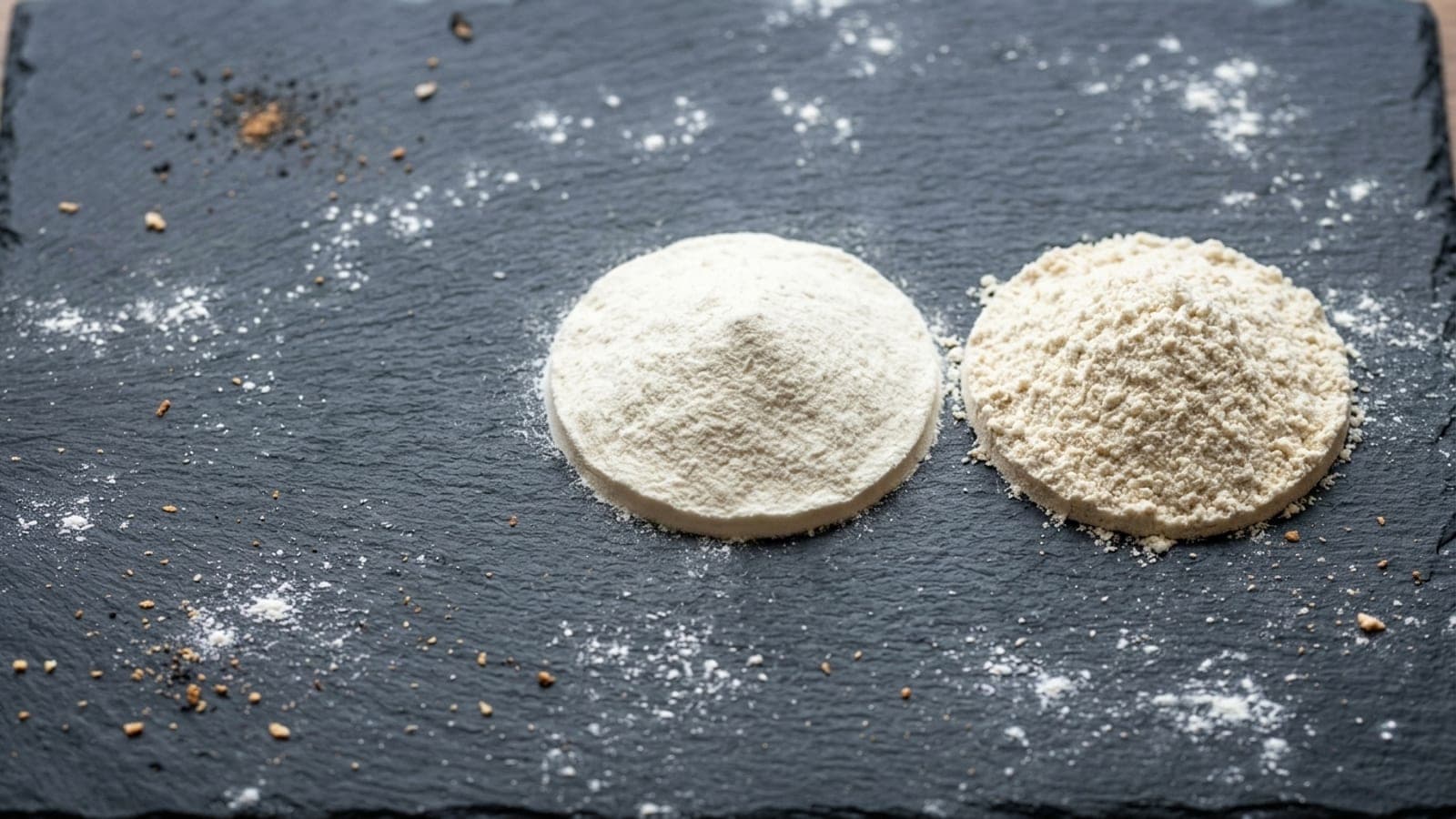
00 flour vs bread flour — the guide
The internet’s favorite flour fight is secretly a category error: 00 names how finely a flour is milled, bread flour names how strong it is. One is a texture, the other is a muscle — which is why the answer to “which is better?” is always another question: better for which pizza?
This page is the head-to-head: the two bags side by side, which of the 10 styles here wants which, and the swaps that work versus the one that quietly ruins a weekend. The wider story — protein, W strength and all the other bags — has its own guide.
Two answers to different questions
00 is an Italian milling grade — the finest of them — and says nothing about strength: a pizzeria 00 is fine and strong, a supermarket pastry 00 is fine and feeble. The fine grind is what makes Neapolitan dough feel like silk and stretch without a fight.
Bread flour is an anglophone strength category — 12.5–14% protein, grind unspecified — the dependable workhorse behind New York rounds and nearly every pan style. When the two bags that pizza actually uses meet, they’re close cousins: a pizzeria 00 and a good bread flour overlap at 12.5–13.5% protein. The fight was never about strength.
Side by side
| Pizzeria 00 | Bread flour | |
|---|---|---|
| Protein | 12–13.5% | 12.5–14% |
| W strength | W 260–320 | rarely printed |
| Grind | talcum-fine | coarser |
| Browning | slow, blaze-proof | faster, malt-assisted |
| Feels like | silk | denim |
The browning row is the sleeper: most anglophone bread flour is malted, which feeds browning at home-oven temperatures — and turns to char at a pizza oven’s. A true 00 browns slowly on purpose, so it can sit in a 450 °C blaze for ninety seconds and come out leopard-spotted instead of carbonized. Each bag is tuned to its own oven.
Which styles want which bag
Every preset’s bag, with the oven it was tuned for:
| Style | The bag | Protein | Oven |
|---|---|---|---|
| Neapolitan | Pizzeria 00 | 12–13.5% | 450 °C |
| Thin & crispy | All-purpose or light 00 | 10.5–12% | 300 °C |
| Pinsa | Pinsa blend or strong 00 | 12.5–14% | 300 °C |
| Roman teglia | Strong 00 or bread flour | 13–14.5% | 250 °C |
| Focaccia | Bread flour or strong 00 | 12.5–14% | 220 °C |
| New York | Bread flour | 12.5–14% | 290 °C |
| Sicilian | Bread flour, splash of semola | 12.5–14% | 230 °C |
| Detroit | Bread flour | 12.5–14% | 250 °C |
| Grandma | Bread flour | 12–13.5% | 260 °C |
| Tavern | All-purpose | 10–11.5% | 290 °C |
Read the last column and the pattern settles the argument: every style whose bag reads bread flour bakes at 290 °C or below, while the 450°C bake at the top of the table belongs to a 00. The two flours aren’t rivals — they’re assigned to different ovens.
Swapping one for the other
Bread flour in a Neapolitan recipe — works, honestly. In a home oven you may never taste the difference; the crumb chews a touch more and the surface browns a little faster, which a domestic bake can use. At a real 450 °C blaze the swap shows: more char, less leopard, a sturdier bite where silk was the point.
Pizzeria 00 in a New York recipe — also fine, and a quiet upgrade if the bag is strong: same protein neighborhood, silkier handling. Expect a paler pie at 290 °C — no malt means less browning help — so give it the full bake time.
The one swap that fails is the invisible one: a weak supermarket 00 standing in for either. Same label as the pizzeria bag, half the endurance — it mixes beautifully and then collapses somewhere into day two of a cold ferment. Read the protein number, not the grade.
Questions from the counter
Can I use bread flour for Neapolitan pizza?
Yes — and at home-oven temperatures it’s arguably the smarter bag, since the extra browning works for you instead of against you. The 00 earns its premium when the oven gets serious: past the home ceiling, malted flour chars while 00 spots. Same grams either way — the recipe doesn’t change.
My 00 dough tore after two days in the fridge — isn't 00 the pizza flour?
You met the weak kind. 00 promises fineness, not endurance — a pastry-grade 00 runs out of gluten long before a long plan runs out of days. For multi-day fermentation look for 12%+ protein or a W around 260 and up on the bag; the flour guide explains the W ladder.
Do I need to adjust the water when I switch?
Between a pizzeria 00 and bread flour, barely — they drink similarly, and the calculator’s percentages are flour-agnostic. The adjustment moment is a strength change, not a label change: dropping to all-purpose or a light 00, start a notch drier; the hydration guide covers reading the dough’s vote.
Where does all-purpose flour land in this fight?
Outside it, comfortably: all-purpose is the gentle middle that two presets here run on — thin & crispy and tavern style, the rolled-thin crackly rounds where extensibility beats muscle. It’s not a 00 substitute or a bread-flour substitute; it’s the right answer to a different question.
Pick a bag, weigh it
Whichever side of the aisle you land on, the calculator scales the dough to your batch — the flour type changes the feel, never the math. Working from a recipe in cups? The cups-to-grams converter knows what each flour weighs.
The clock is a suggestion. The dough is the boss. In bocca al lupo!