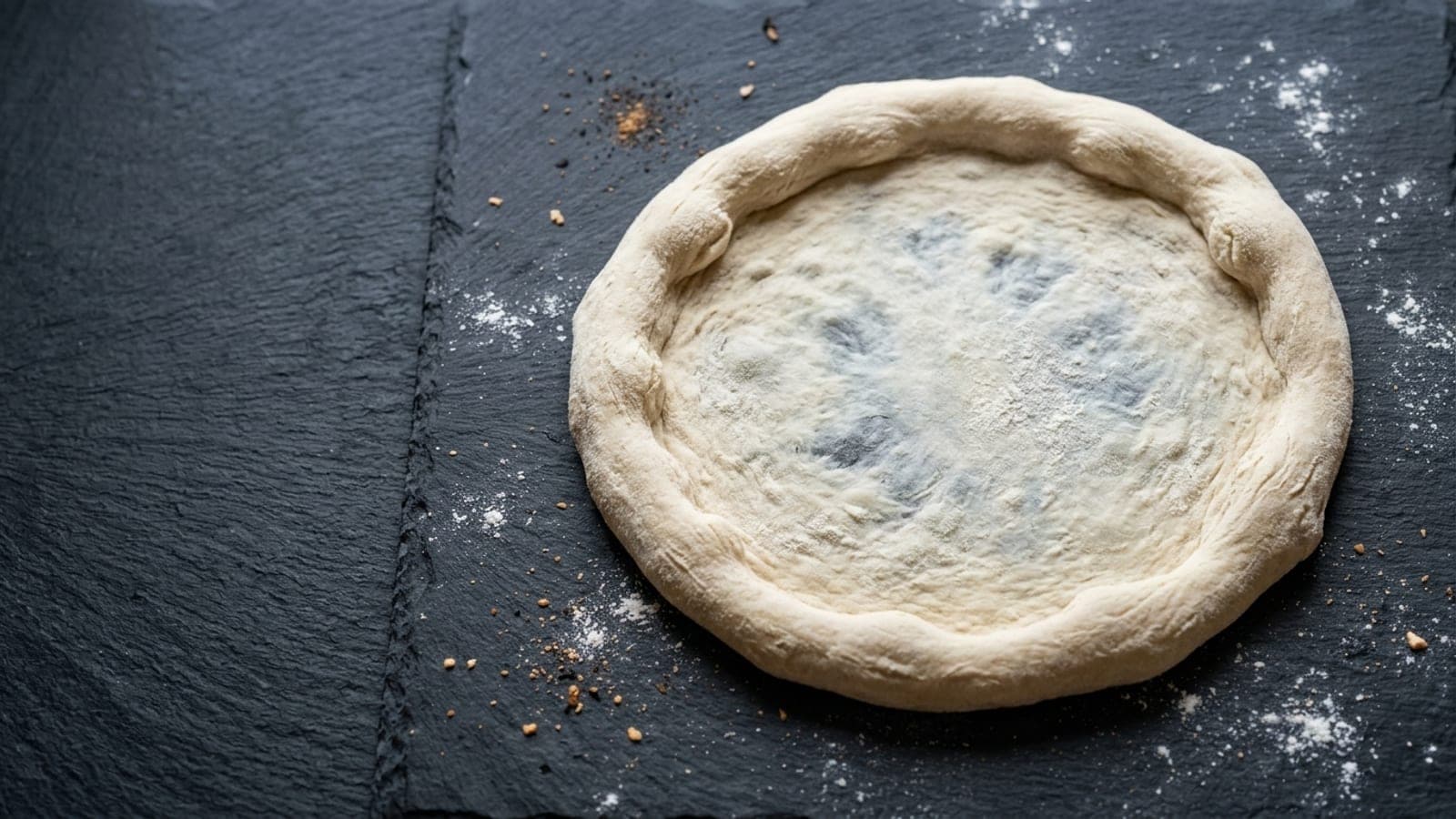
Stretching & shaping pizza dough — the guide
Everything else in pizza runs on a schedule. The stretch takes thirty seconds at the bench — and it’s where good dough gets ruined. Here’s the consoling secret: stretching is barely a skill. Rested, room-warm dough practically opens itself; cold, tight dough fights a professional.
This guide is that half-minute in pictures: the rest that earns you an easy stretch, the hand sequence step by step, the styles that want a rolling pin or a pan instead, and what to do the moment the dough pushes back.
The rest does the stretching
Gluten is a spring: pull it and it pulls back, leave it and it relaxes. A dough that resists isn’t failing — it’s early. Warm gluten extends, cold gluten recoils, and no amount of thumb strength changes that arithmetic.
Out of the fridge, give the balls their wake-up: the calculator’s schedule parks them at room temperature for the last two hours before baking, and that’s the difference between silk and a rubber band — the cold ferment guide has the whole timeline. The readiness check is a gentle poke: a ball that takes a fingerprint and refills it slowly is ready; one that snaps back flat is not.
And if a round fights you mid-stretch, stop pulling. Cover it, walk away for fifteen or twenty minutes, and it will open where it stalled — the gluten relaxes on its own. The won’t-stretch fix sorts cold from under-rested if it keeps happening.
The hand stretch, in pictures
1 · Flour and lift. Dust the bench and the ball, then free it with a scraper in one confident scoop — keep it round, seam side down. Brush off what flour doesn’t cling; a dry crust is how tears start.
2 · Press, don’t pull. Fingertips flat, press from the center outward, turning the disc as you go. The rim never gets touched — the gas you’re herding outward has to live somewhere, and that somewhere is the cornicione.
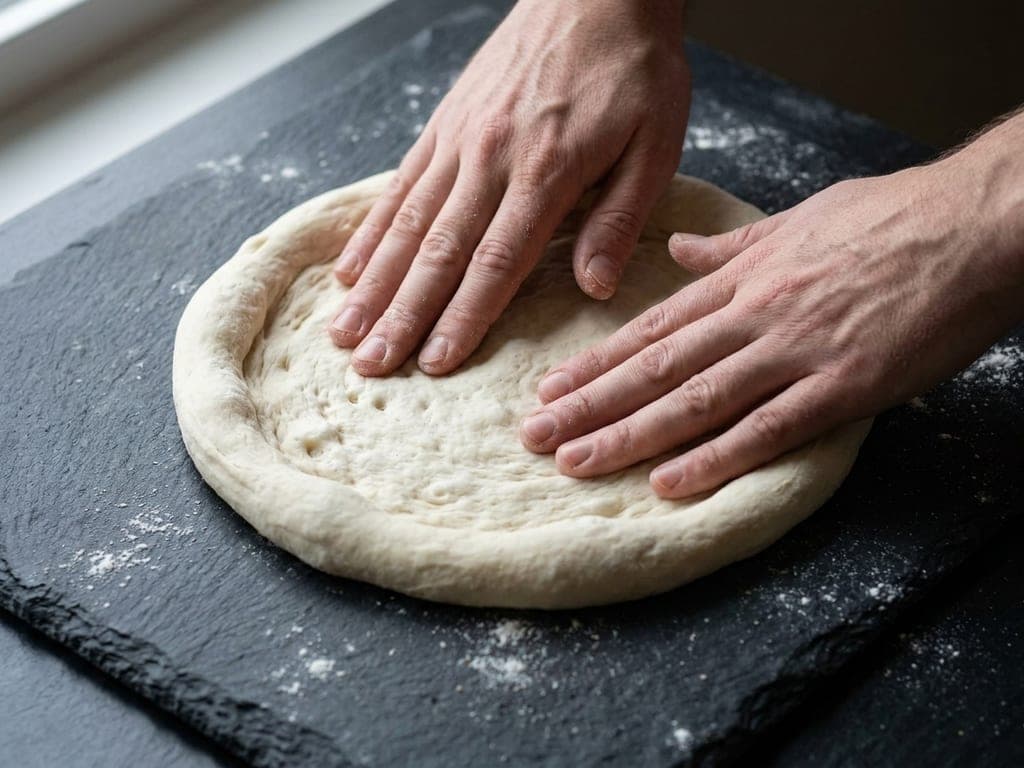
3 · Over the knuckles. At about two-thirds size, lift the disc onto the backs of both hands, knuckles up, and turn it like a slow steering wheel. Gravity does the widening; your hands just keep moving the thick spots over the edge of your fists.
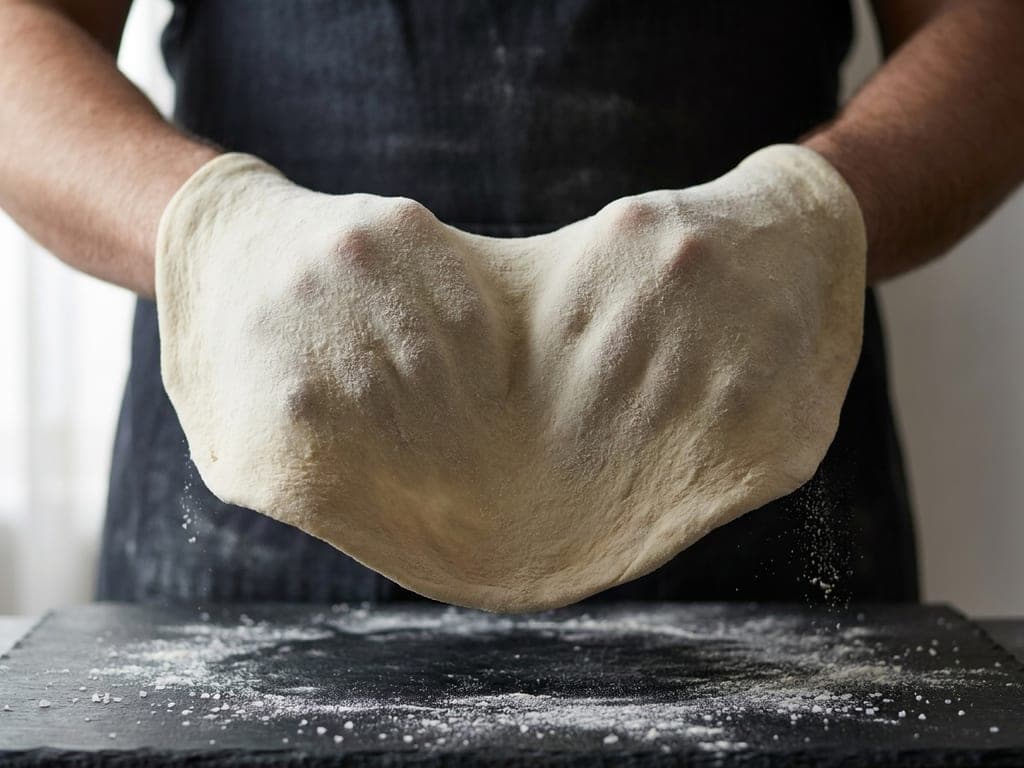
4 · Land and read it. Lay the round down and look through it against the bench: the middle should be evenly thin, the rim fat, no pale over-stretched windows. A 260 g Neapolitan ball lands at about 29 cm; New York’s 320 g goes wider, around 35 cm and thinner. If a hole opens, the tears fix is the patch kit.
Neapolitan — press from the center out and never touch the last bit of rim — that's the cornicione.
New York — stretched wider and more even than Naples — a modest rim, no thick center.
Pinsa — pressed into its oval with fingertips and left puffy — never stretched wide.
Rolled flat, pressed into pans
Not every style wants the airborne treatment. Two of ours are rolled — and no, the pin isn’t cheating there: a cracker crust is flat by design, so the pin’s gas-crushing honesty is exactly the tool. Roll thin, dock with a fork, bake crisp.
Thin & crispy — rolled cracker-thin with a pin — flat is the point, so roll without mercy.
Tavern — rolled thin and docked all over so it bakes flat and crisp.
The 5 pan styles skip the bench theatrics entirely: the dough is stretched or dimpled straight into its oiled pan, and the pan decides the shape. Wet doughs spring back — stretch in two sittings, ten minutes apart, rather than forcing the corners. The pan size guide matches dough weight to pan.
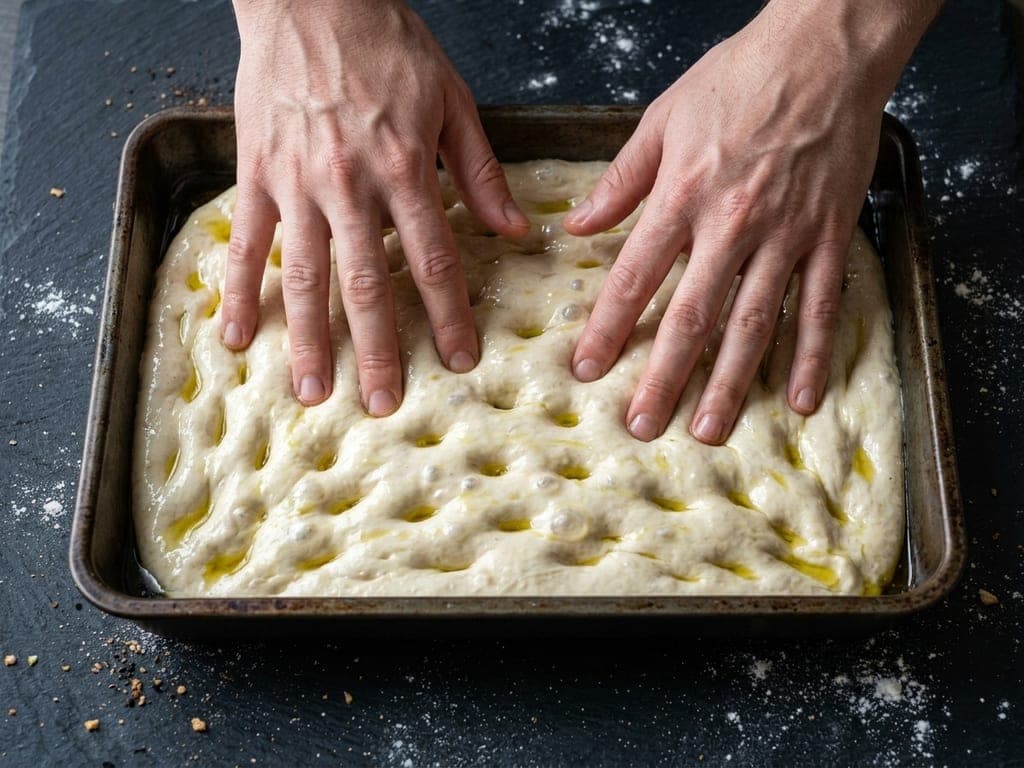
Roman teglia — stretched across the oiled pan in two sittings — it springs back, so wait it out.
Sicilian — pressed to the corners with flat fingers; rest it mid-press when it fights.
Detroit — pressed to the corners; the cheese, not the dough, owns the edges.
Focaccia — dimpled rather than stretched — oiled fingertips pressed to the pan floor.
Grandma — a thin press into an oiled sheet, baked not long after — no second rise to undo.
Style by style
Every preset, its shaping method, and what the default ball opens into — or the pan that shapes it instead.
| Style | Shaped | Ball / pan |
|---|---|---|
| Neapolitan | By hand | 260 g → ≈ 29 cm |
| New York | By hand | 320 g → ≈ 35 cm |
| Pinsa | By hand | 230 g → ≈ 23 cm |
| Thin & crispy | Rolling pin | 180 g → ≈ 30 cm |
| Tavern | Rolling pin | 250 g → ≈ 34 cm |
| Roman teglia | In its pan | 40 × 30 cm pan |
| Sicilian | In its pan | 33 × 33 cm pan |
| Detroit | In its pan | 35 × 25 cm pan |
| Focaccia | In its pan | 30 × 22 cm pan |
| Grandma | In its pan | 35 × 35 cm pan |
The diameters come from each style’s stretch density; the pizza size guide runs that math in both directions, ball to inches and back.
The windowpane, and walking away
Want to know before you stretch whether the dough will hold? Pinch off a knob and ease it thin between your fingers. Developed gluten stretches into a translucent pane you can read the window through; weak gluten shreds at the first pull — give it more rest, or a couple of folds, and test again.
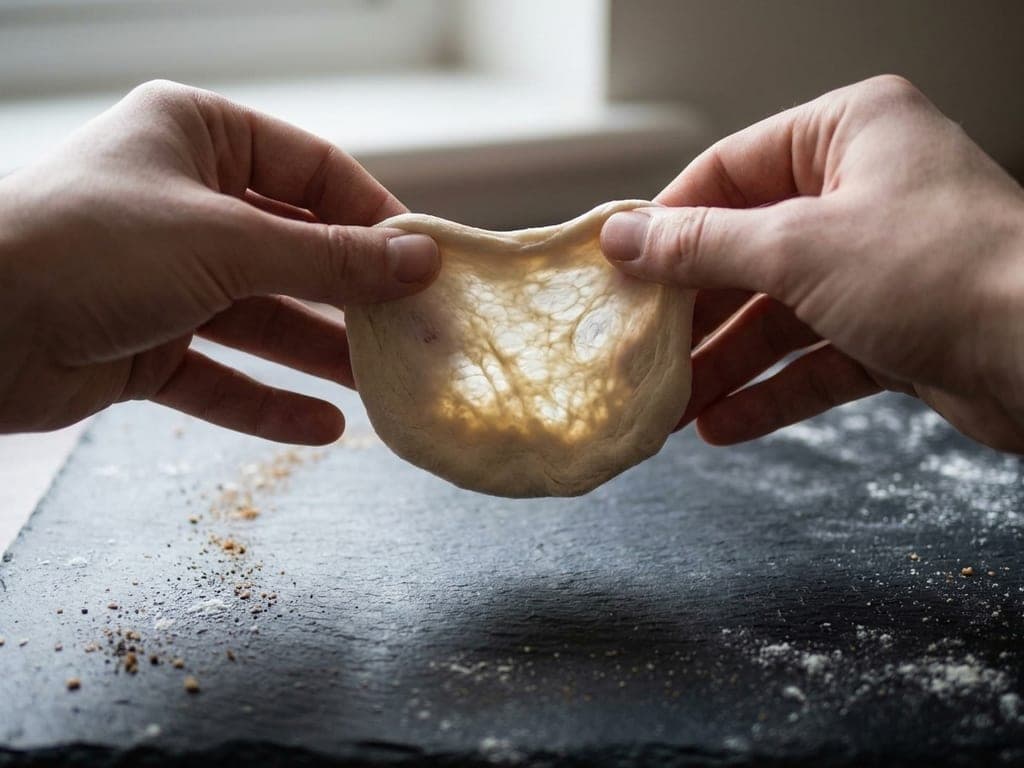
And the most underrated move in pizza: leaving the room. Nearly every stretching disaster — spring-back, tears, lopsided rounds — is solved by fifteen minutes of patience rather than any technique. The dough knows how to relax; your only job is to let it.
Questions from the bench
Is a rolling pin cheating?
Only where a rim is the point. The pin crushes the gas bubbles your ferment spent hours building, so on Neapolitan or New York it trades the cornicione for convenience. On the rolled styles the flatness is the style — pin away, guilt-free.
Why does it spring back like elastic?
Cold or under-rested gluten — almost never anything you did at the bench. Warm it up, wait it out, and try again; the won’t-stretch fix walks the diagnosis.
How big should the round end up?
Whatever the ball weight says it should: diameter follows √weight, so size is decided at balling time, not at the bench. The pizza size guide has the weights for every inch mark.
Can I stretch it on parchment?
Yes — build the pizza on parchment and slide paper and all onto the steel (the base bakes a shade paler; pull the paper after two minutes if you mind). It’s the easy way around launch anxiety while your peel skills grow — the stuck-to-the-peel fix covers the brave way.
The dough comes first
A good stretch is mostly a good recipe wearing gloves: right hydration, right rest, right ball weight. The calculator writes all three for your schedule.
The clock is a suggestion. The dough is the boss. In bocca al lupo!