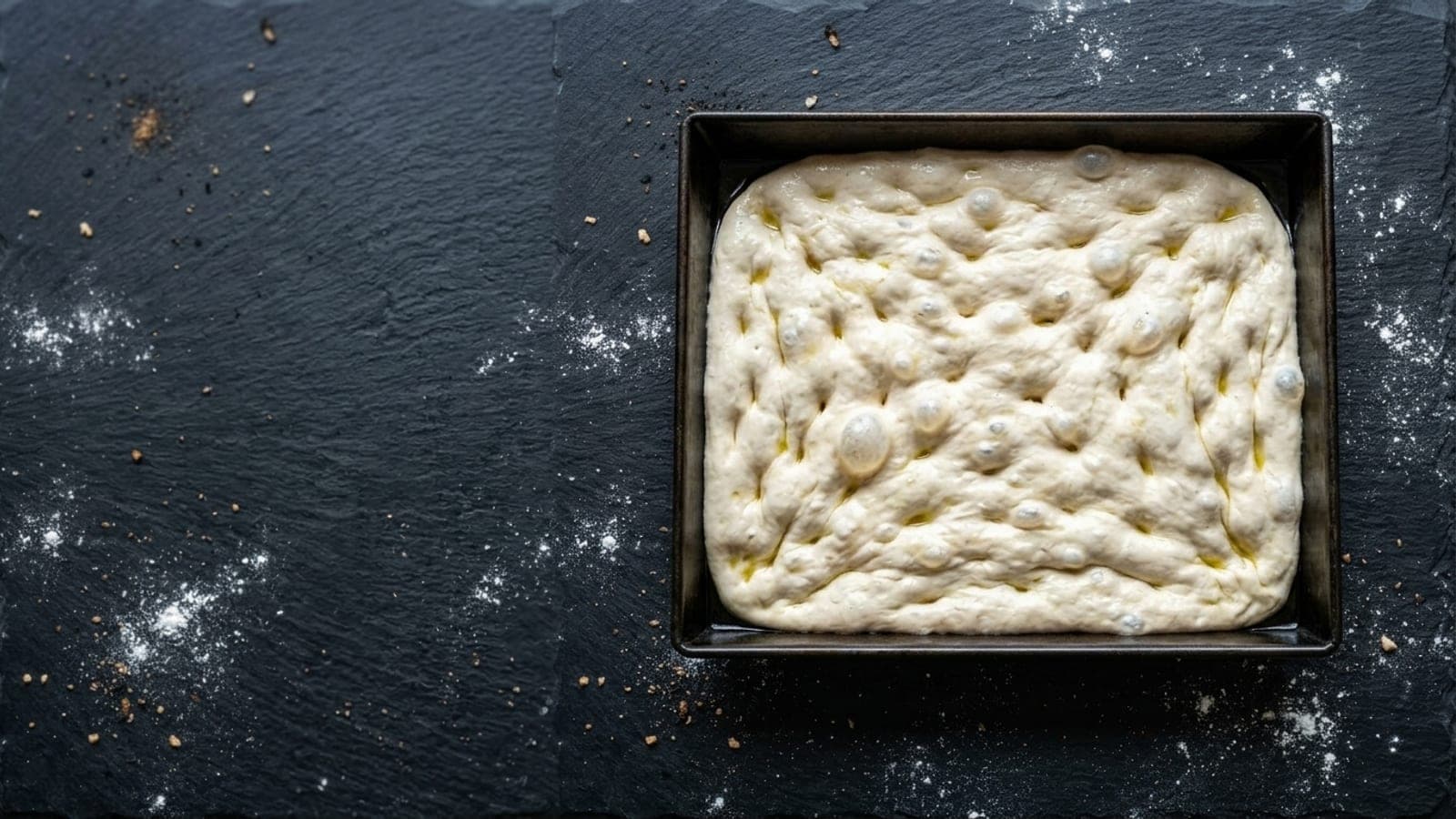
Pan sizing for pizza dough — the guide
“How much dough for a 40 × 30 pan?” deserves a better answer than a shrug, and it has one: multiply the pan’s area by the style’s dough density. That one rule — grams per square centimetre — sizes every pan pizza, every pan, every batch.
This guide unpacks the rule, weighs the common pans for all four pan styles, and covers the two practical wrinkles: round pans and personal thickness taste. The calculator runs the same arithmetic the moment you type your pan’s size.
Grams per square centimetre
A pan pizza’s thickness is decided before the oven: it’s how much dough you spread over how much pan. So each pan style carries one number — dough density in g/cm² — and the weight is just width × height × density.
Roman teglia runs 0.58 g/cm², so the classic 40 × 30 cm baker’s pan (1200 cm²) wants 696 g of dough. Different pan? Same rule. Working in inches? An inch is 2.54 cm, so a square inch is 6.5 cm² — or just convert the sides and let the calculator multiply. What temperature the filled pan goes into is the oven guide’s department.
Four styles, four densities
The density is the style’s signature. Teglia sits lowest — a comparatively lean slab blown open by its hydration. Focaccia adds a little more depth for the dimples and the oil. Detroit climbs higher to fill its tall steel sides, and Sicilian tops the list: a thick, spongy sfincione crumb that takes about 29% more dough than teglia in the very same pan.
| Style | g/cm² | Default pan | Dough |
|---|---|---|---|
| Teglia | 0.58 | 40 × 30 cm | 696 g |
| Sicilian | 0.75 | 33 × 33 cm | 817 g |
| Detroit | 0.72 | 35 × 25 cm | 630 g |
| Focaccia | 0.65 | 30 × 22 cm | 429 g |
| Grandma | 0.52 | 35 × 35 cm | 637 g |
Density decides how much dough goes in the pan; hydration decides what it bakes into — all four sit high on the hydration ladder, because the pan does the shape-holding that drier doughs do themselves.
Dough for common pans
The same rule, worked through the pans that live in most kitchens (the inch sizes are converted at 2.54 cm to the inch):
| Pan | Teglia | Sicilian | Detroit | Focaccia | Grandma |
|---|---|---|---|---|---|
| 40 × 30 cm | 696 g | 900 g | 864 g | 780 g | 624 g |
| 33 × 33 cm | 632 g | 817 g | 784 g | 708 g | 566 g |
| 35 × 25 cm | 507 g | 656 g | 630 g | 569 g | 455 g |
| 30 × 22 cm | 383 g | 495 g | 475 g | 429 g | 343 g |
| 33 × 23 cm · 13 × 9 in | 440 g | 569 g | 546 g | 493 g | 395 g |
| 46 × 33 cm · 18 × 13 in | 880 g | 1139 g | 1093 g | 987 g | 789 g |
Your pan isn’t here? It doesn’t need to be — type its width and height into the calculator and it weighs the whole recipe for that exact pan, flour to yeast.
Round pans
The calculator thinks in rectangles, but a round pan is only an area wearing a different shape: π × radius². The shortcut — keep the diameter as the width, and enter 79% of it as the height. That rectangle has almost exactly the circle’s area, because π/4 ≈ 0.79.
So a 28 cm round pan becomes 28 × 22 cm in the calculator. Check the arithmetic for focaccia: the true circle (616 cm²) wants 400 g; the stand-in rectangle weighs in at 400 g. Close enough to dimple.
And if the round you’re sizing is a stretched pizza rather than a pan, the pizza size guide runs the same arithmetic per ball style — 12-inch, 16-inch and friends.
Thicker or thinner, to taste
The densities are the styles’ canonical numbers, not law. The polite way to bend them is to lie to the calculator about your pan: enter a slightly bigger pan for a thicker pizza, a smaller one for thinner — the dough still goes in the pan you own.
Ten percent on one side is a noticeable nudge: tell it 40 × 33 instead of 40 × 30 and the teglia plan grows from 696 g to 766 g — same pan, plusher slab. (For the ball styles, thickness lives in the ball weight slider instead.)
Questions from the counter
Why does the same pan want different amounts of dough?
Because the amount isthe style. A teglia spread thick stops being teglia; a Sicilian spread thin is just sad. The density encodes each style’s crumb height, so the pan fills to the character you picked.
Does higher hydration mean I need less dough?
No — the target is finished-dough weight, water included. Hydration changes what the grams bake into (open caves versus tight sponge), not how many grams the pan wants.
My pan has sloped sides — which size do I enter?
Measure the base, inside edge to inside edge. That’s the area the dough actually covers; the slope above it is the pan’s business, not the dough’s.
How deep does the pan need to be?
A few centimetres of headroom is plenty for teglia and focaccia; Detroit wants its tall steel walls (that’s where the frico edge comes from), and Sicilian likes depth for its sponge. If your pan is shallow, nudge the entered size up a touch and bake a thinner one.
Can I bake a ball style in a pan?
Better to switch presets: the pan styles aren’t just shapes, they’re recipes — wetter, oilier doughs designed to be poured and dimpled rather than stretched. Craving New York thickness in a pan? That’s roughly what Detroit is for.
Your pan, weighed
Pick a pan style, type the size stamped on (or measured from) your pan, and the calculator turns it into a full recipe — dough weight, flour, water, schedule and all.
The clock is a suggestion. The dough is the boss. In bocca al lupo!