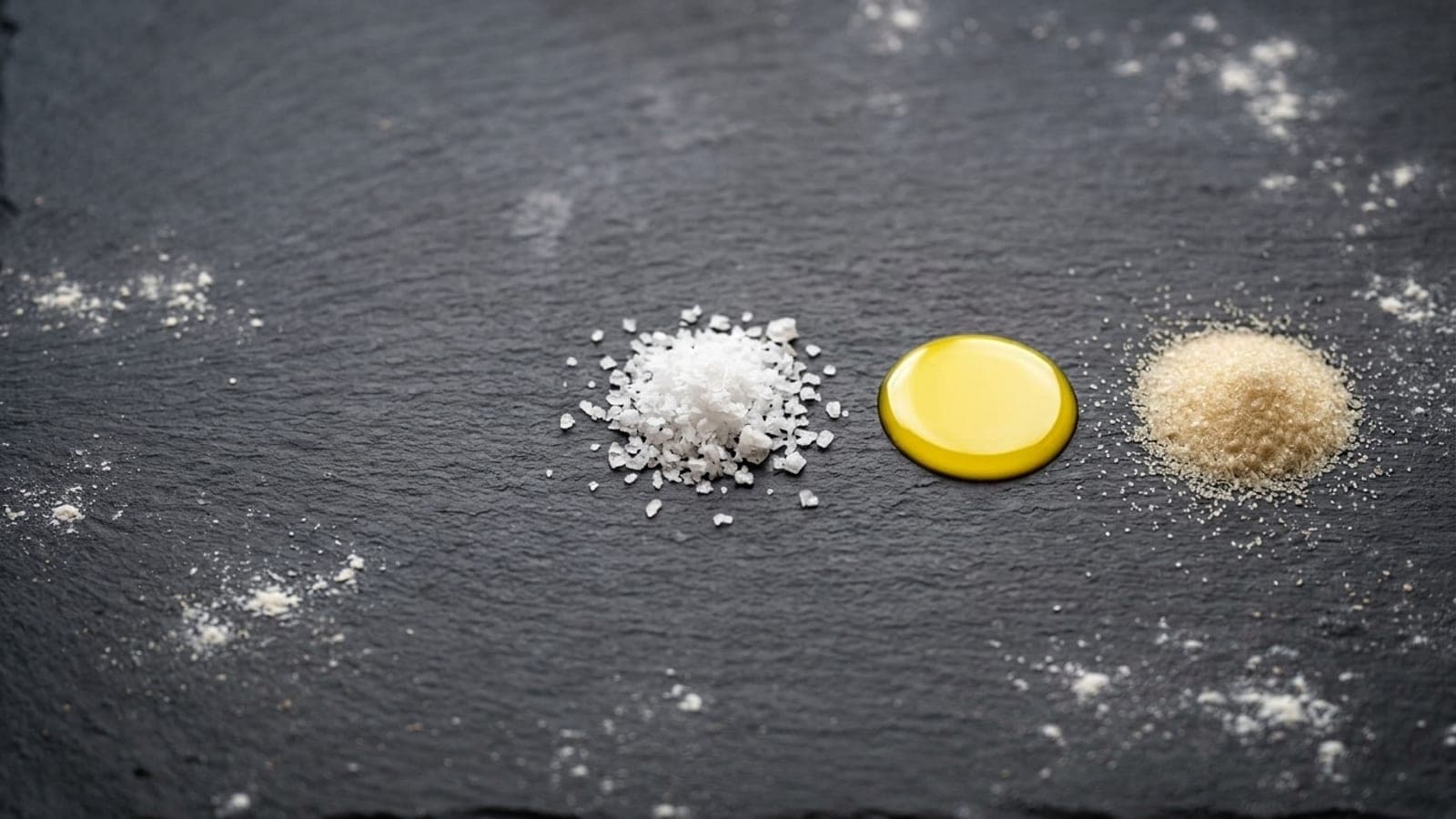
Salt, oil & sugar in pizza dough — the guide
Flour, water and yeast get all the poetry. But the three small numbers at the bottom of the formula — salt, olive oil, sugar — are where a style gets its manners: how the crust tastes, how it browns, how a slice folds instead of cracking.
This guide explains what each one actually does and how much the styles use — every percentage below comes from the same presets the calculator runs, so the numbers here and the sliders there can never disagree.
Salt — the disciplinarian
Salt does three jobs. It seasons (obviously). It tightens the gluten, turning a slack, sticky dough into one with posture. And it taps the brakes on the yeast, evening out the fermentation. Dough without salt isn’t just bland — it’s structurally lazy and ferments like it’s late for something.
It’s also the narrowest dial on the whole panel: the styles run from 2% to 2.8%, and that’s the entire argument. On 500 g of flour, Neapolitan’s 2.8% is 14 g — weigh it, because a “teaspoon” of salt swings wildly between fine and flaky. Any salt without additives works; fine sea salt dissolves fastest.
When to add it: with most of the water, or after a short flour-and-water rest. Just don’t leave dry yeast sitting in a salt pile on the scale — in the mixed dough they coexist fine (more on the myth below).
Olive oil — the tenderizer
Oil coats the flour’s proteins and shortens gluten strands — literally what “shortening” means — so the crumb turns tender and the crust browns richer and faster. It’s also insurance against staling: an oiled dough stays soft on the second day, which is why delivery styles lean on it. (Crust baking up tough? The hard-crust fix sorts the causes — missing oil is one of them.)
Every style here uses some, except one: Neapolitan — at 450 °C, oil would just burn, and tradition says flour, water, salt, yeast and nothing else. At the other end sits focaccia at 4% — plus more oil in the pan and over the dimples, where it shallow-fries the crust into its golden self. Pan styles generally love oil twice: in the dough and under it.
Sugar — the browning agent
Sugar in pizza dough isn’t about sweetness — at 1.5% and under you’ll never taste it. It’s fuel for color: a little extra food for the yeast, and free sugars left over for the Maillard reaction, so the crust browns properly in an oven that isn’t Italian-fierce.
Which is exactly where the presets put it: New York, Sicilian, Detroit, Tavern — all home-oven styles baking at 290 °C (554 °F) or below. The blistering bakes don’t carry any: at Neapolitan temperatures sugar doesn’t brown, it carbonizes.
Skipping it? Fine — a long cold ferment frees sugars of its own, which is why a three-day fridge dough browns beautifully with nothing added.
Every style’s seasoning row
The full panel, next to the oven that explains it — note how the sugar column lights up exactly where the temperatures drop.
| Style | Salt | Oil | Sugar | Oven °C |
|---|---|---|---|---|
| Neapolitan | 2.8% | — | — | 450 |
| New York | 2.5% | 2.5% | 1.5% | 290 |
| Roman teglia | 2.2% | 2% | — | 250 |
| Sicilian | 2.2% | 3% | 1% | 230 |
| Detroit | 2.2% | 2% | 1% | 250 |
| Thin & crispy | 2.5% | 2.5% | — | 300 |
| Focaccia | 2.2% | 4% | — | 220 |
| Pinsa | 2.4% | 2% | — | 300 |
| Grandma | 2.2% | 3% | — | 260 |
| Tavern | 2% | 3% | 1% | 290 |
The oven’s side of that story — steel, stone, pans and preheats — has its own guide.
Questions from the counter
Does salt kill yeast?
Not at dough concentrations. The myth comes from real harm at point-blank range: dry yeast left sitting in direct contact with a heap of salt suffers. Mixed through a dough, 2–2.8% salt only moderates the yeast — which is part of its job description.
Can I leave the sugar out of a New York dough?
Yes. You’ll lose a shade of color and a hint of chew, nothing structural. Counter the pallor with a longer cold ferment or a slightly hotter bake — or use diastatic malt, the bakery version of the same trick.
Extra-virgin, or does any oil do?
Inside the dough, any decent olive oil — the perfume mostly bakes off. Where extra-virgin earns its price is wherever you can still taste it: the focaccia pan, the post-bake drizzle, the marinara.
My crust tastes flat — more salt?
Check the percentage before the shaker: under 2% reads as flat, so weigh against the flour and see where you land. If the salt is right, the missing flavor is usually time — ferment longer, not saltier.
Enough theory
In the calculator’s Pro mode, salt, oil and sugar are sliders — move them and every gram re-weighs instantly. For the formula-nerd version, the baker’s percentage calculator runs the math in both directions.
The clock is a suggestion. The dough is the boss. In bocca al lupo!