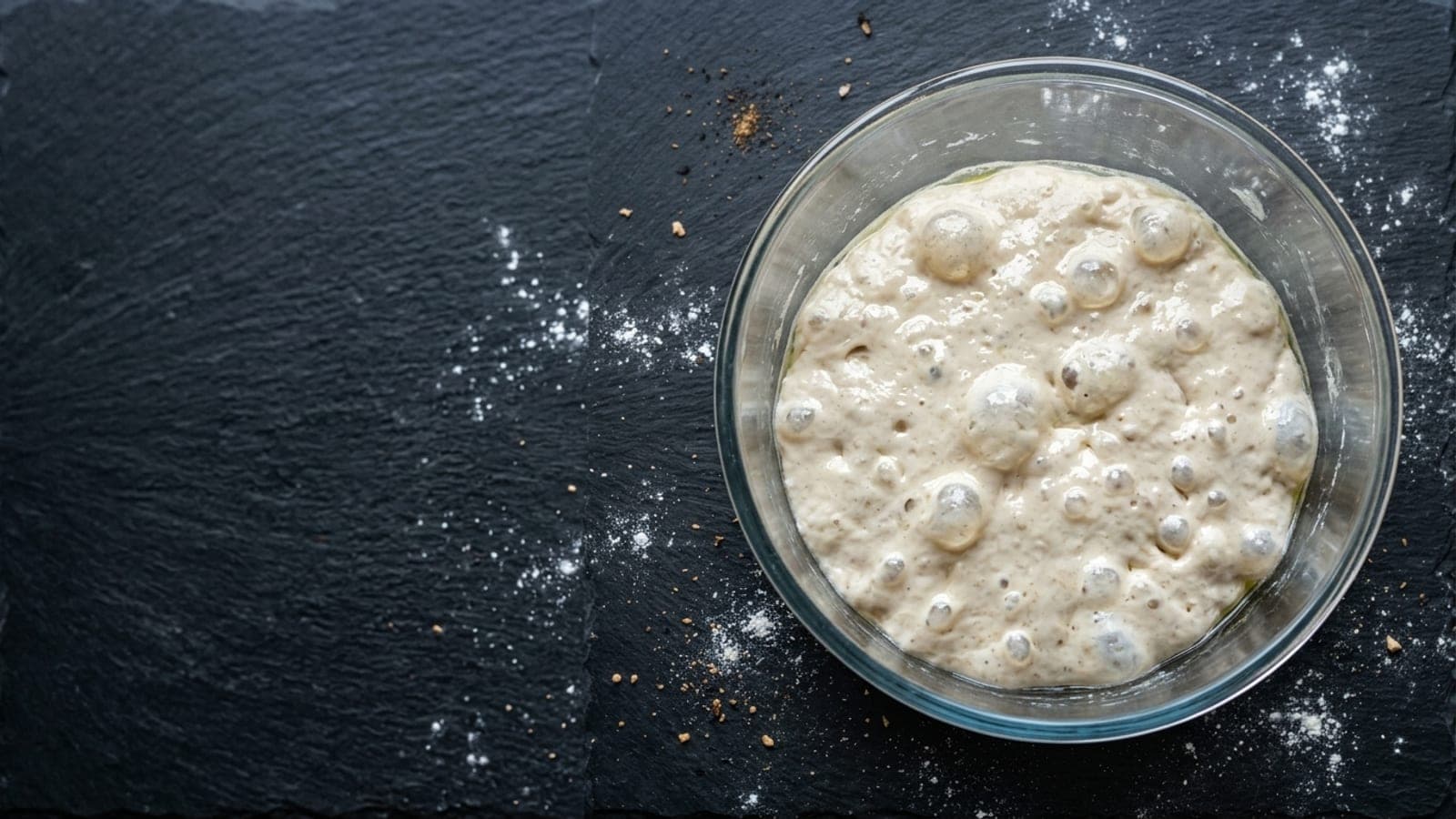
Hydration in pizza dough — the guide
Hydration is the weight of the water as a percentage of the weight of the flour — 500 g of flour and 300 g of water is 60%. One number, and it decides more about your pizza than any other: how the dough feels in your hands, how open the crumb bakes, how crisp the crust shatters.
Impasto’s 10 styles span 52% to 80% — from a thin crust that rolls out like pasta to a focaccia that pours more than it stretches. This guide explains what the number means, what changes as it climbs, and how to handle the wet end without panicking.
Baker’s percentages
Bakers write every ingredient as a percentage of the flour, and the flour is always 100%. So “62% hydration” means 62 g of water for every 100 g of flour — at 500 g of flour, that’s 310 g of water. Salt, oil and yeast are written the same way (our styles run 2–2.8% salt and up to 4% oil — what each of those does is the salt, oil & sugar guide’s story).
The point of the convention: percentages scale to any batch size and make any two recipes comparable at a glance. The calculator thinks in baker’s percentages all the time — flip on Pro mode to see the % column next to the grams.
The hydration ladder
Same four ingredients, very different pizzas. Here are the 10 presets, driest to wettest:
| Style | Water | Oil | In the hand |
|---|---|---|---|
| Tavern | 52% | 3% | stiff, cracker-thin |
| Thin & crispy | 56% | 2.5% | stiff, rolls thin |
| Neapolitan | 62% | — | soft, pliable |
| New York | 63% | 2.5% | smooth, chewy |
| Grandma | 65% | 3% | soft, oily |
| Sicilian | 70% | 3% | slack, spongy |
| Detroit | 70% | 2% | slack, plush |
| Roman teglia | 78% | 2% | wet, wants folds |
| Focaccia | 80% | 4% | almost a batter |
| Pinsa | 80% | 2% | very wet, airy |
Notice the pattern: the ball-shaped pizzas sit low and middle, because a ball has to hold its shape and stretch over knuckles. The pan styles sit high — the pan does the shape-holding, and all that extra water turns to steam in the oven and blows the crumb open.
(How much dough those pans want is its own arithmetic — the pan size guide weighs the common sizes by the square centimetre.)
What more water does
In the crumb: water makes steam, steam makes holes. Climbing the ladder takes you from a tight, even crumb to the big glassy caves of a Roman teglia.
In the hand: wetter dough is more extensible — it stretches easily and relaxes fast — but holds its shape worse and sticks to everything it meets.
In the oven: high hydration loves high, long-enough heat: the water has to leave before the crust can crisp. That’s why wet doughs live in pans in fierce ovens, and why a 52% tonda bakes to a snap that an 80% focaccia never could (nor wants to). Pull a wet dough early and you get a gummy crumb — the gummy-center fix covers that rescue.
Handling wet dough — the 72% rule
From 72% hydration upward, the calculator quietly rewrites the method: instead of 8–10 minutes of kneading, it prescribes 3 sets of stretch-and-folds, 20 minutes apart. Wet dough builds gluten on its own schedule — you just fold it over itself now and then and let time do the kneading; the kneading guide covers both kinds of work. (And when it’s finally time to open it, the stretching guide takes over at the bench.)
The survival kit: wet your hands before touching the dough (water sticks to water less than dough sticks to skin), keep a bench scraper close, and resist the urge to fix stickiness with flour — every spoonful you add quietly lowers the hydration you chose on purpose. Sticky is not a mistake; it’s the recipe.
The other half of handling wet dough is buying the right bag: high hydration wants strong, high-protein flour — the flour guide pairs a bag with every style.
Weigh it — the cups problem
Hydration only exists by weight. A “cup of flour” can weigh anywhere from about 105 g (spooned gently) to 140 g (scooped and packed) — that single scoop swings your hydration by ten points, which is the whole distance from New York to Sicilian.
If you must use volume, the calculator’s “cups” mode converts at 120 g of flour and 237 g of water per cup, and the cups-to-grams converter does it for any flour by type. But a €10 kitchen scale ends the argument forever, and the yeast wants one anyway — that’s its own guide.
Questions from the counter
Is higher hydration better?
No — it’s a style choice, not a skill ladder. The 52% tonda is dry on purpose: that’s what makes it snap. Pick the pizza you want to eat, then use its water level.
My dough is too sticky — should I add flour?
Almost never. Do a fold, wait twenty minutes, and it will be a different dough — gluten tightens with each fold and stickiness fades. Save the flour for dusting the bench at shaping time. Still fighting it? The sticky-dough fix sorts the causes.
Does hydration change how much yeast I need?
No. The yeast dose follows time and temperature, not water. Wetter dough can feel faster because it relaxes and spreads, but the clock is set by the yeast math, same as ever.
Can I change a preset's hydration?
Yes — Pro mode unlocks the hydration slider (salt, oil and sugar too). Move it a few points and watch the water line re-weigh itself; ±3% is plenty to feel the difference in your hands.
Does oil count toward hydration?
No — oil is its own percentage. It softens the crumb, browns the crust and doesn’t feed gluten the way water does. Our styles run from zero (Neapolitan) to 4% (focaccia), counted separately from the water.
Pick your water level
The calculator weighs flour, water, salt and oil for any style and any batch — and swaps in the wet-dough method automatically when you cross the 72% line.
The clock is a suggestion. The dough is the boss. In bocca al lupo!