Cold fermentation in pizza dough — the guide
The cheapest upgrade in pizza is a cold shelf and a little patience. Cold fermentation means letting balled dough spend a day or three in the refrigerator, where the yeast slows to a crawl while flavor keeps quietly accumulating.
This guide covers what actually happens in there: how the calculator counts fridge hours, what changes between 24, 48 and 72, why your fridge’s real temperature matters, and how to tell ready from ruined. For the dose itself, see the yeast guide; for the water, the hydration guide.
What the fridge actually does
Fermentation speed roughly doubles every 7 °C — and the slide works both ways going down. At a typical 4 °C, one fridge hour counts for about 12 minutes of room-temperature fermentation, and a full day counts as only about 4.9 hours. The dough isn’t paused; it’s moving in slow motion.
The trick is that the slowdown isn’t even. The yeast (gas) slows down more than the enzymes and bacteria (flavor), so a long cold rest stacks up sugars, acids and aroma faster than it stacks up bubbles. That’s why a 48-hour dough browns deeper and tastes rounder than tonight’s batch ever could.
The plans
Every plan below is the same choreography — about two hours on the counter at 21 °C, the rest at 4 °C. Longer naps want smaller pinches:
| The plan | Counts as | IDY | IDY / 500 g flour |
|---|---|---|---|
| Tonight → tomorrow (2 h + 16 h) | 5.5 h | 0.36% | 1.8 g |
| 24 hours (2 h + 22 h) | 6.7 h | 0.30% | 1.5 g |
| 48 hours (2 h + 46 h) | 11.6 h | 0.17% | 0.9 g |
| 72 hours (2 h + 70 h) | 16.6 h | 0.12% | 0.6 g |
These are examples, not gospel: set the fridge toggle and your real hours and temperatures in the calculator, and it weighs the dose for your kitchen — not for this table’s.
Day by day
Day one (18–24 h): the biggest single jump you’ll ever taste. The dough relaxes, handles better than any same-day batch, and the flavor turns from plain to gently wheaty.
Day two (around 48 h): the sweet spot for most kitchens. Extensible, aromatic, blistering beautifully in the oven — this is the dough that makes people ask what changed. (Those big charred bubbles are a feature, mostly.)
Day three (around 72 h): maximum flavor, minimum margin. The dough is slacker, browns noticeably faster (watch the oven), and sits at the edge of overproof. Beyond that, gluten starts to give: the calculator’s fridge slider stops at 96 hours for a reason. Need to park dough longer than the slider allows? The freezing guide picks up where the fridge stops.
Your fridge matters
“Fridge temperature” is not one number. At 7 °C, dough ferments about 35% faster than at 4 °C — over three days, that’s the difference between perfect and past it. The calculator accepts 2–8 °C, so don’t guess: a cheap fridge thermometer settles it once.
Geography matters too. The door is the warmest neighborhood in the fridge and the back wall the coldest — park the dough box deep at the back, not in the door next to the milk.
The choreography
The calculator’s schedule runs: mix → short rise on the counter → divide and ball → into the fridge → out about two hours before baking. Ball before the nap: cold dough is too stiff to shape nicely, and the balls tighten their skin and relax into shape while they rest.
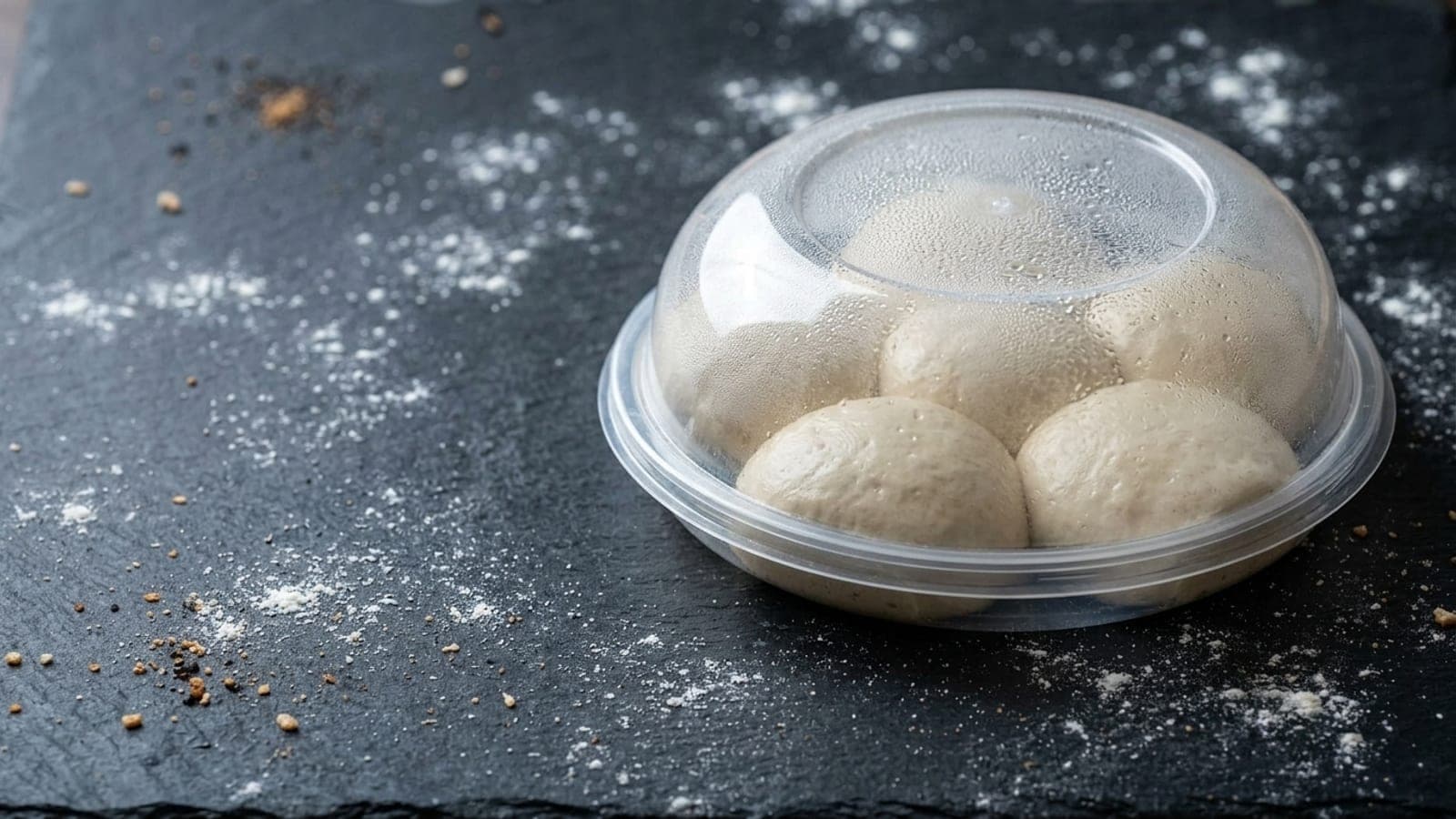
Use a lidded, lightly oiled container with room to grow — even in the cold, dough expands over a few days. And respect the wake-up: straight-from-fridge dough springs back and tears, while two hours on the counter (the schedule plans them) makes it stretch like it wants to be pizza.
Ready or ruined?
Ready: roughly doubled, domed, jiggly. A gentle finger-poke springs back slowly and leaves a shallow dimple. Smells sweet and faintly tangy.
Overproofed: collapsed or flat-topped, big surface bubbles, a poke that never fills back in, and a smell that’s moved from tangy to boozy. The dough tears instead of stretching — the overproof fix covers the rescue.
The rescue: re-ball gently, rest 1–2 hours at room temperature, and accept a slightly humbler rim — or roll it thin and call it scrocchiarella night. Niente panico.
Questions from the counter
Which styles like the fridge?
New York famously — the slow ferment builds its flavor and that deep golden color. But every preset works cold; for the pan styles, do the final proof in the pan at room temperature after the nap.
Can I stretch the dough straight from the fridge?
You can, but it will fight you — cold gluten springs back and tears. Two hours on the counter covers most kitchens; wet, high-hydration doughs forgive a little sooner. If it still won’t stretch, the fix walks through why.
My plans changed — can the dough wait another day?
Usually yes; the colder your fridge, the more grace you have. Past 72 hours, check it daily against the ready-or-ruined signs above and bake at the first hint of boozy.
Can I freeze dough instead?
Freezing is storage, not fermentation — it stops the clock and costs a little yeast vigor. Freeze after balling, thaw overnight in the fridge, then give it a normal wake-up on the counter.
Why does cold-fermented pizza brown better?
While the yeast naps, enzymes keep splitting starch into simple sugars. Come bake time that extra sugar caramelizes — the deeper color and the rounder flavor are the same chemistry.
Tonight, the fridge
Flip “Let it nap in the fridge” in the calculator, set your real hours and temperatures, and the schedule writes itself — mix, ball, nap, wake-up, bake.
The clock is a suggestion. The dough is the boss. In bocca al lupo!