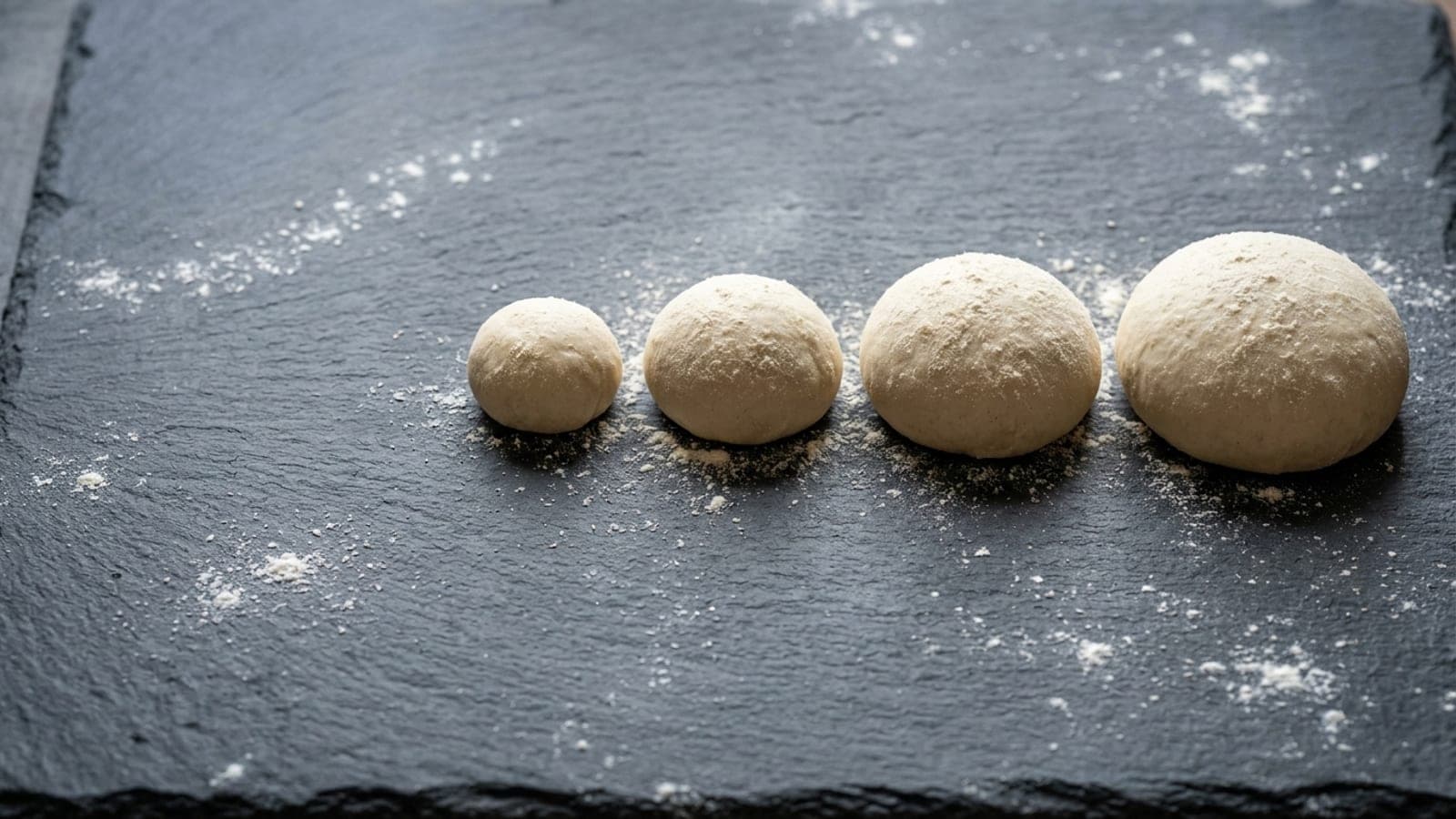
Pizza size and ball weight — the guide
How much dough for a 12-inch pizza? For a New York round, about 241 g; for a Neapolitan with its proud rim, closer to 292 g. Behind both answers is one small rule, and this guide is about using it for any size you’re after.
It’s the stretched-round sibling of the pan size guide: same arithmetic, different shape — and the same warning that thickness is a style’s identity before it’s a personal preference.
From size to ball weight
A stretched pizza, like a pan, is dough spread over area: ball weight = π r² × the style’s stretch density. The densities (rim included) run 0.4 g/cm² for Neapolitan — the puffy cornicione concentrates dough at the edge — 0.33for New York’s thin-but-foldable economy, and 0.25 for cracker-thin scrocchiarella.
Working in inches? Multiply by 2.54 first — or just read the table below, which does both units for you.
Dough for common sizes
The rule, worked through the sizes people actually order:
| Pizza | Neapolitan | New York | Thin & crispy | Pinsa | Tavern |
|---|---|---|---|---|---|
| 10 in · 25 cm | 203 g | 167 g | 127 g | 279 g | 142 g |
| 12 in · 30 cm | 292 g | 241 g | 182 g | 401 g | 204 g |
| 14 in · 36 cm | 397 g | 328 g | 248 g | 546 g | 278 g |
| 16 in · 41 cm | 519 g | 428 g | 324 g | 713 g | 363 g |
Set the ball-weight slider to the number you want and the calculator scales the whole batch. One honest footnote: a 16-inch Neapolitan is restaurant fantasy in a home kitchen — most ovens, steels and peels top out around 13 inches, and the preset sliders are bounded accordingly.
Reading it backwards
What the calculator’s default balls stretch into:
| Style | Default ball | Stretches to | |
|---|---|---|---|
| Neapolitan | 260 g | ≈ 29 cm | 11.3 in |
| New York | 320 g | ≈ 35 cm | 13.8 in |
| Thin & crispy | 180 g | ≈ 30 cm | 11.9 in |
| Pinsa | 230 g | ≈ 23 cm | 9.1 in |
| Tavern | 250 g | ≈ 34 cm | 13.3 in |
So the presets already encode sensible homes: Neapolitan lands near the classic personal round, New York at a generous foldable-slice size, thin & crispy at a full-plate cracker.
Bigger, smaller, thicker, thinner
Diameter grows with the square root of weight: a fifth more dough makes a pizza only about 10% wider. That’s why size disappointments are usually stretch problems, not dough problems — and why doubling a party pizza means doubling the dough, not adding a little.
For thickness taste, move the ball-weight slider while keeping your stretch size: the New York preset runs 250–450 g, which at a 14-inch stretch spans from svelte to deep-lunch. The densities above describe the canonical middle, not the law.
The cornicione tax
One Neapolitan honesty clause: the rim eats the real estate. A 2.5 cm cornicione on a 30 cm pizza claims about 31% of the area — toppings live on what’s left. That’s the style working as intended (the rim is the point), but if you’re sizing for hungry guests, count eating area, not diameter — or go New York, where the rim is a formality.
Questions from the counter
Why does mine come out two inches smaller than the table?
Spring-back. Cold or under-rested gluten pulls the round back in — the table assumes a full, relaxed stretch. Let the balls warm and rest until they take a fingerprint without fighting, then stretch in stages.
Can I stretch the 320 g New York ball to 16 inches?
Physically yes — but do the math: that’s 0.25g/cm², which is exactly thin & crispy territory. It’ll bake brittle, not foldable. A true 16-inch New York wants about 428 g of dough.
My baking steel is 33 cm — what size do I make?
Size to the steel minus a thumb of margin: 30–31 cm, so the launch can be imperfect and the rim still lands on metal. Feeding more people? More pizzas, not bigger ones — they bake better and arrive hotter.
Does hydration change the size?
No — grams are grams, and the table only weighs them. Wetter dough does stretch more willingly, so high-hydration rounds reach the table’s numbers with less wrestling.
What about pan pizzas?
Different arithmetic, same idea — pans go by width × height × the pan style’s density. The pan size guide has the lookup tables, including round pans.
Size your next ball
Pick the diameter you want from the table, set the ball weight, and the calculator weighs the batch and writes the schedule.
The clock is a suggestion. The dough is the boss. In bocca al lupo!