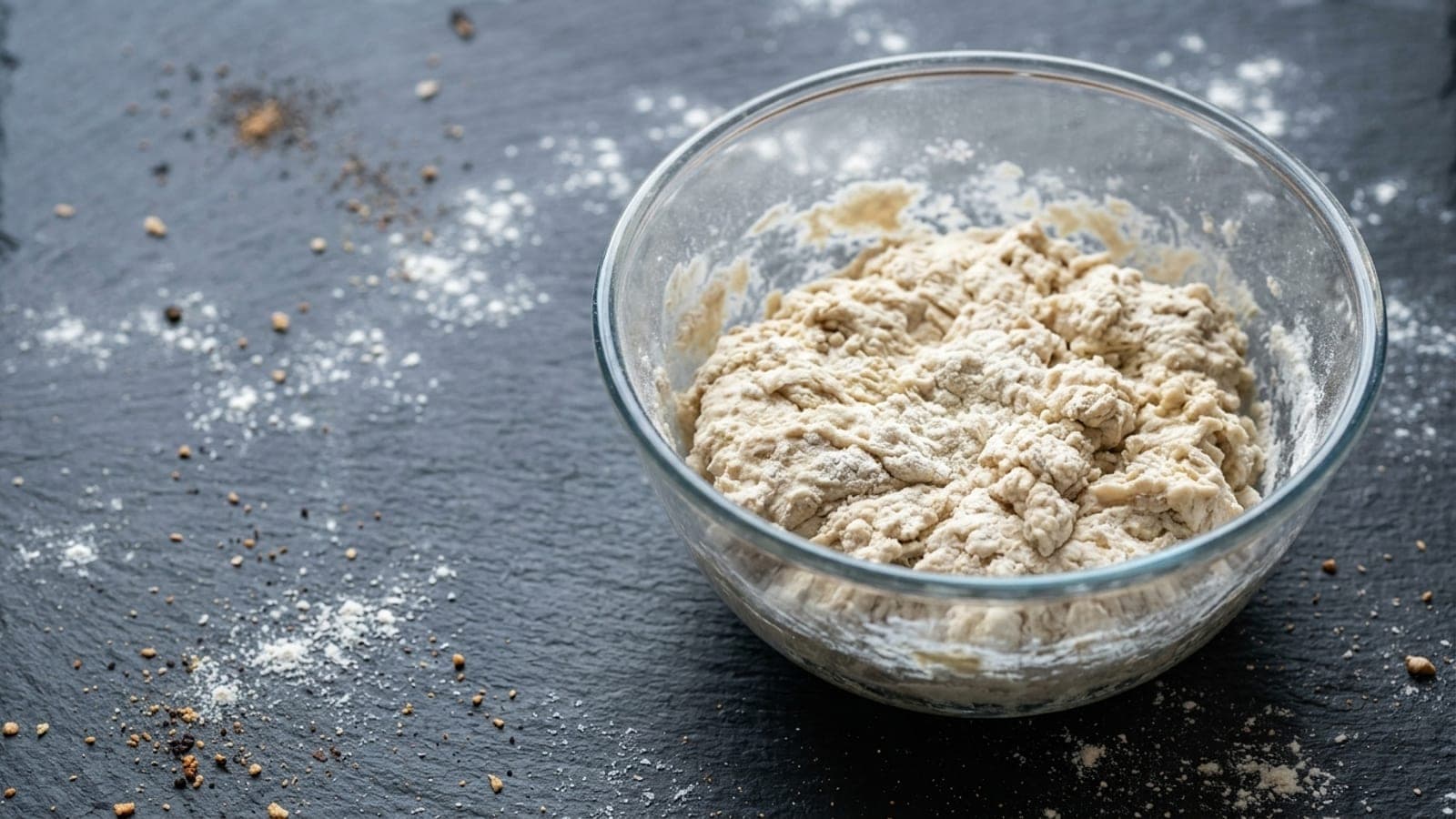
Same-day pizza dough — the guide
You decided on pizza this morning and you want to eat it tonight. No three-day fridge plan, no poolish set the evening before — dough, today. Good news: the calculator does same-day without a single special setting. You just don’t flip the fridge toggle.
This guide is the same-day half of the model: how a short warm rise trades time for a bigger pinch of yeast, the doses by how many hours you actually have, the warm-spot trick that buys you speed, and the honest part — what a few hours can’t give you that a cold night can. For the long, slow route, the cold fermentation guide is its mirror image.
The whole trick: more yeast, less time
Fermentation is a deal between yeast and time, and you can pay with either. A long rise needs only a crumb of yeast; a short one needs more to reach the same rise before dinner. Impasto sets the dose inversely — fresh yeast % ≈ 6 ÷ effective hours — so when you tell it you have three hours instead of three days, it simply weighs you a bigger pinch. Same dough, same arithmetic, dialled fast.
In the calculator that’s one move: leave “Let it nap in the fridge” switched off and set the counter rise to the hours you’ve got. No fridge stage, no preferment — a single warm rise from mix to oven. Everything below is just that, at different clock settings.
The doses, by the hours you have
A typical 21 °C kitchen, one rise on the counter, ready when the table says. Read it top-down: the less time you give the dough, the more yeast it takes to get there.
| You have | Fresh | IDY | IDY / 500 g flour |
|---|---|---|---|
| Ready in ~2 hours | 2.7% | 0.91% | 4.5 g |
| An afternoon (4 h) | 1.4% | 0.45% | 2.3 g |
| Most of a day (6 h) | 0.91% | 0.30% | 1.5 g |
| Out the door (8 h) | 0.68% | 0.23% | 1.1 g |
The pattern is the model’s whole personality: at one temperature, halving the time roughly doubles the pinch — the two-hour dough wants about four times the yeast of the eight-hour one. These are examples at 21 °C; set your real hours and kitchen temperature in the calculator and it weighs the dose for your room, not this table’s.
Warm it up to go faster
Temperature is the other lever, and it’s a strong one: fermentation speed roughly doubles every 7 °C. A 28 °C dough ferments about 2× as fast as a 21 °C one — so the same recipe is ready in half the time, or reaches dinner on half the yeast. When the clock is tight, warmth is free speed.
Cheap ways to find a few degrees: mix with warm (not hot) water, around 32–35 °C; rest the bowl somewhere cosy — near the oven, in a turned-off oven with just the light on, or on top of the fridge; and cover it so it doesn’t chill or skin over. Set that warmer number in the calculator and the dose drops to match — don’t keep summer-kitchen yeast for a cold counter.
What you trade
Same-day dough is real pizza — billions of pizzerias prove it nightly — but be honest about the swap. The flavor a long ferment builds (the nutty, faintly sweet depth, the deep browning from broken-down starch) comes from time, and a few warm hours simply haven’t had it. A same-day crust is cleaner and breadier; lovely, just younger.
You also pay in yeast — a two-hour dough wants roughly 3 times the pinch of an overnight cold ferment — and a bigger dose, rushed, can tip toward a faintly beery edge if you let it overshoot. If you ever do have a spare night, even one stint in the fridge is the cheapest upgrade in pizza: the cold ferment guide makes the case in full.
Make a rushed dough good anyway
Knead it properly. A long rest develops gluten on its own; a same-day dough doesn’t get that grace, so you build the structure by hand. Knead until smooth and elastic — the kneading guide has the feel and the timing.
Still give it a real rest before shaping. Even in a hurry, 15–20 relaxed minutes after balling lets the gluten settle so the dough opens instead of fighting back — see the stretching guide. Skip it and you’ll meet dough that won’t stretch.
Don’t wander off. A warm, well-yeasted dough moves fast — its window is shorter than a fridge dough’s, so watch the rise, not the clock. Bake it when it’s puffy and jiggly; let it sail past and you’re into overproofed territory.
Questions against the clock
Can you really make pizza dough in 2 hours?
Yes. Set a 2-hour rise (warm helps) and the calculator dials the yeast up to suit — around 2.7% fresh, the top row above. It won’t have the depth of an overnight dough, but it’s a genuine, good pizza on a weeknight.
How much yeast for same-day dough?
More than you’re used to seeing, because the time is short. The table has it by the hour — roughly 0.45% IDY of the flour weight for a four-hour rise, more for less time. The calculator weighs the exact gram for your hours, temperature and yeast type.
Is same-day worse than cold-fermented?
Not worse — younger. You trade the slow-built flavor and deep color of a 24–72 h ferment for speed and convenience. If you have even one night, the fridge is the bigger upgrade; if you don’t, a warm same-day dough is a perfectly good pizza.
Can I make it even faster than two hours?
A little: push the kitchen warmer (the 7 °C rule) and the dough is ready sooner. But there’s a floor — the yeast caps at 4% fresh in the model, and past it you’re just baking bready, beery dough. Under about 90 minutes, reach for flatbread or a no-yeast base instead.
Which styles suit same-day?
The leaner rounds and pan styles are the most forgiving in a hurry — New York, tavern, thin & crispy, the Detroit and Sicilian squares. A true Neapolitan cornicione is happiest with a longer rise, but a same-day Margherita is still a fine thing. Every preset works either way.
Dough tonight
Leave the fridge toggle off, set the counter rise to the hours you’ve got, and the calculator weighs the bigger pinch and writes a same-day schedule — mix, rise, ball, bake.
The clock is a suggestion. The dough is the boss. In bocca al lupo!